
Cricket bat
A flat-fronted wooden bat used by batters to hit the ball in cricket, with a curved back that concentrates weight behind the hitting area.
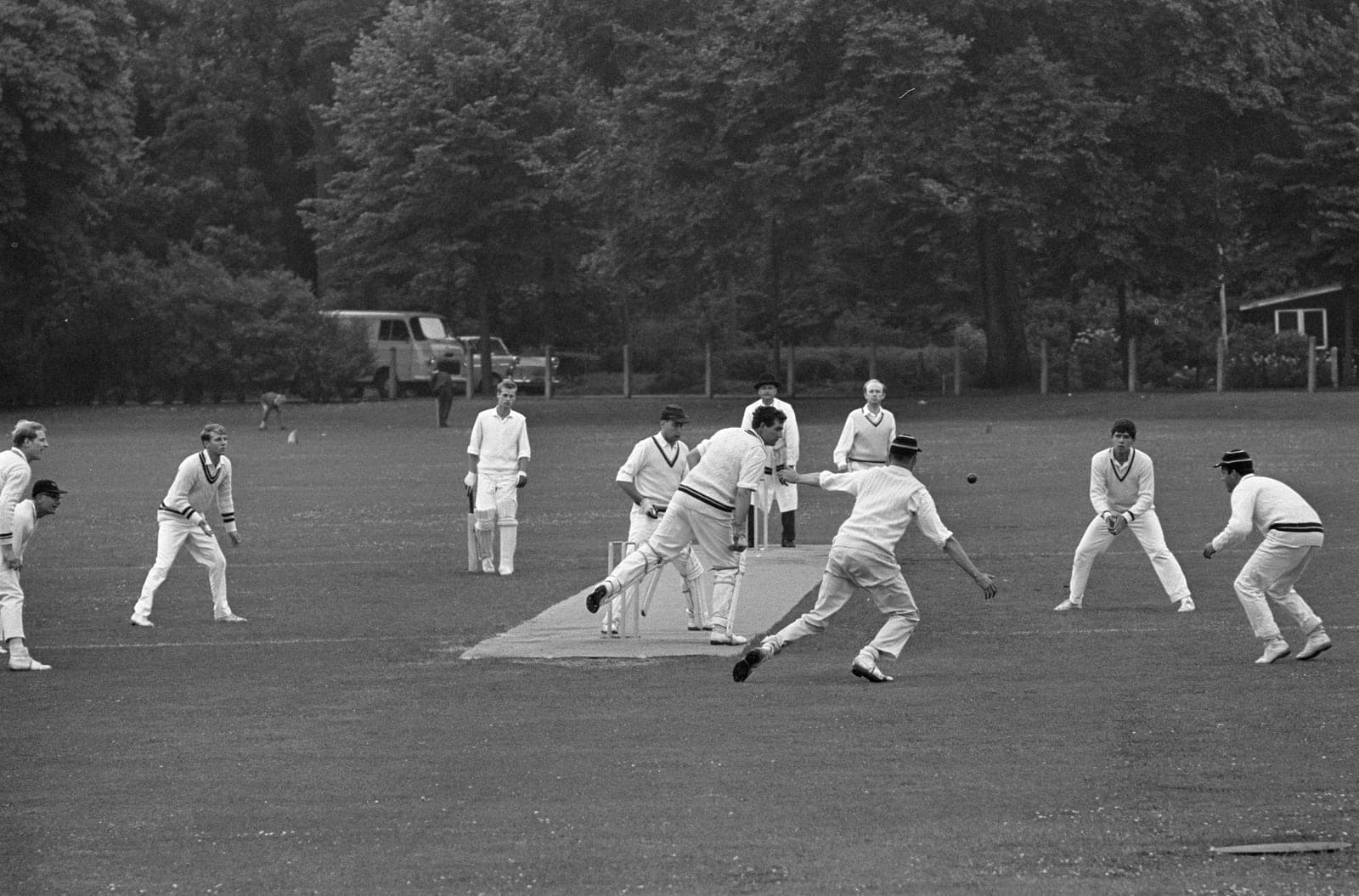
,_bowler_Vri,_Bestanddeelnr_916-6339.jpg)
Overview
A cricket bat is made of wood, with a flat striking face on the front, a ridged back for strength, and a handle wrapped in a rubber grip. Batters use it to defend their wicket and to score runs by hitting the ball into the field.
The bat is held with both hands and is designed so that its flat face can guide the ball along the ground or drive it into the air, depending on the shot.
Good to know
- The front face is flat; the back is ridged for strength.
- Held with both hands to play a range of shots.
- Used to both defend the wicket and score runs.
Where it’s used
Sports that use cricket bat:
Related equipment
Wickets, stumps and bails
The three stumps and two bails a bowler aims at and a batter defends — their exact height, width and shape, and what the Laws say about when bails may be dispensed with.
The cricket ball
What a cricket ball weighs and measures in men's, women's and junior cricket, who controls the ball during a match, and the rules on taking a new ball after 80 overs.
How it connects
The meaning-bearing relationships that place Cricket bat in the wider knowledge graph — each one with the reason it exists.
Frequently learned together
Taught side by side in the same stage of a learning path.
- Wickets, stumps and bailsBoth are taught in the “What you’ll need” stage of the Cricket learning path.
- The cricket ballBoth are taught in the “What you’ll need” stage of the Cricket learning path.
- The cricket pitchBoth are taught in the “What you’ll need” stage of the Cricket learning path.
- The cricket field and boundaryBoth are taught in the “What you’ll need” stage of the Cricket learning path.
- Artificial turfBoth are taught in the “What you’ll need” stage of the Cricket learning path.
Explore across the knowledge base
Follow the threads that connect Cricket bat to the rest of SocialSportHub.
Facilities
- The cricket pitchThe 22-yard strip at the centre of a cricket field where the bowling and batting happen — its exact dimensions, how it is bounded, and who decides whether it is fit to play on.
- The cricket field and boundaryHow the edge of a cricket field is defined and marked, what scores four and what scores six, and why the Laws set no boundary distance while international playing conditions do.
- Driving rangeA practice facility with hitting bays and an open landing area, used to repeat shots without playing a hole.
- Golf courseA large outdoor course of individually designed holes, each running from a teeing area to a hole cut in a putting green.
Playing surfaces
Techniques
- Cricket batting grip and stanceThe starting position every cricket stroke is built from — how the hands sit on the handle, how the feet and head are set, and what the setup decides before the ball is even bowled.
- One-Handed BackhandA backhand groundstroke struck with a single hand on the grip, driving through the ball with a full extension of the hitting arm.
- Bunker ShotThe greenside sand shot where the club enters the sand behind the ball and lifts it out on a cushion of sand.
- Tennis ServeThe overhead stroke that starts every point, hit from behind the baseline into the diagonally opposite service box.
- Swing bowlingHow a cricket ball is made to curve in the air — the seam position and surface asymmetry behind conventional and reverse swing, and why swing is a property of the ball as much as the bowler.
Learning paths
Knowledge Atlas
Go deeper with Cricket bat
Everywhere else on the platform that covers Cricket bat — assembled from what actually references it, so nothing here is a dead end.
Learn it
Structured courses and paths on the platform that cover this directly.
See it
Diagrams and step-through visualisations drawn for this subject.
Kit it out
Equipment guidance drawn from the graph, with no brands and no affiliate links.
Take it away
Open data and the whole-platform view of this subject.
How this page is maintained
- Content type
- Equipment
- Provenance
- Tier A — evergreen educational
- Verified external sources
- 0
- Content updated
- 2026-09-12
Evergreen, first-party explanation — it makes no claim that needs an external source. How we handle sources and reviews.