
Forward and back defence
The two strokes a batter survives with — the forward defensive and the back defensive — when each is the right choice, and why a defensive stroke is a decision about length rather than intent.
Overview
Defensive strokes keep the ball out of the stumps and off the edge without trying to score. In the long format they are the majority of strokes played, and a batter who cannot defend cannot occupy the crease long enough for anything else to matter.
There are two, and the choice between them is decided by length. A ball pitched full enough to be reached is met forward; a ball short enough to be played under the eyes is met back. Choosing the wrong one is what produces edges and LBWs.
The forward defensive
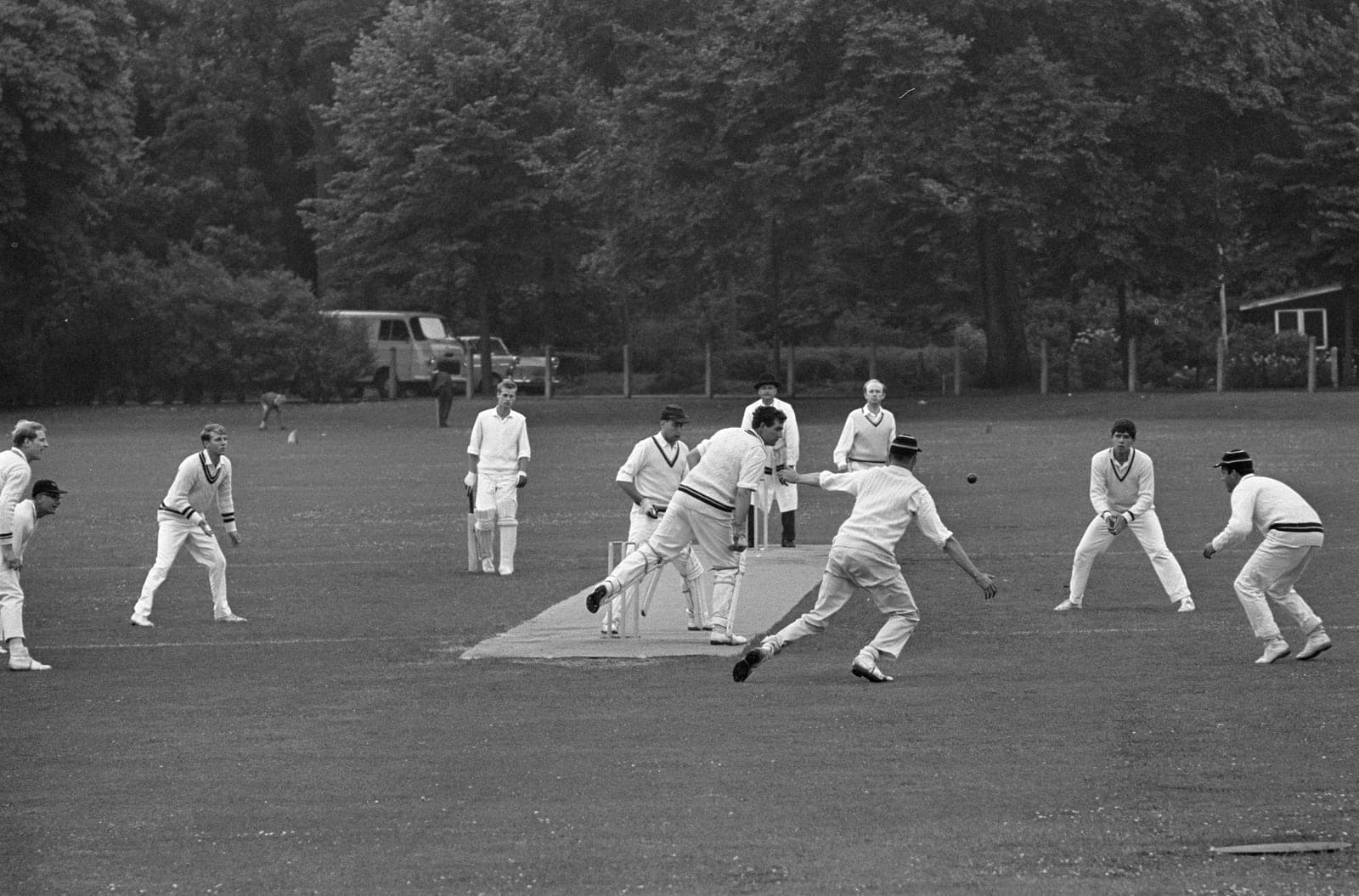
The front foot moves towards the pitch of the ball, and the bat comes down beside the pad with the face angled towards the ground so the ball is deadened rather than pushed away. The head leads and finishes over the ball, which is what keeps the bat coming down straight.
The aim is to meet the ball as close to its pitch as possible. The closer to the bounce it is met, the less distance it has had to deviate — which is why a well-forward defensive stroke survives seam movement that would beat the same stroke played a foot shorter.
The back defensive
The back foot moves back and across towards the line of the ball, giving the batter time and letting the ball come up to a height where it can be played under the eyes. The bat comes down straight, soft-handed, with the ball met beneath the head.
Going back buys time against pace and against extra bounce. It costs something too: moving back moves the body closer to the stumps, so a misjudged back defensive against a full ball is a straightforward LBW.
Soft hands and the edge
A defensive stroke played with a tight grip sends an edge fast and far enough for slip to reach it comfortably. Relaxing the bottom hand at contact — soft hands — drops the ball short of the cordon.
This is the clearest example of a defensive stroke being active rather than passive. The batter is not merely blocking; they are controlling how far the ball travels when the stroke does not go to plan.
How to do it
- 1Read the length as early as possible — that decision, not the shot, is the skill.
- 2For a full ball, move the front foot towards the pitch of the ball, head leading.
- 3Bring the bat down straight beside the pad, face angled downwards.
- 4For a short ball, move the back foot back and across into line instead.
- 5Play the ball under the eyes, with the bat coming down straight.
- 6Relax the bottom hand at contact so any edge falls short of the fielders.
Key points
- The forward defensive meets the ball close to its pitch to minimise deviation.
- The back defensive buys time but brings the body closer to the stumps.
- Length decides which stroke is correct; choosing wrongly causes edges and LBWs.
- The head leads and finishes over or above the ball in both strokes.
- Soft hands at contact keep an edge from carrying to slip.
Where it’s used
Sports that use forward and back defence:
Related techniques
Cricket batting grip and stance
The starting position every cricket stroke is built from — how the hands sit on the handle, how the feet and head are set, and what the setup decides before the ball is even bowled.
The cricket drive
Cricket's foundational attacking stroke, played straight down the ground or through the off side — the cover, straight and on drive, and the length that makes each one available.
The pull and the hook
The two cross-batted strokes that punish short bowling — how the pull and the hook differ, the height of the ball that separates them, and the risk each one carries.
How it connects
The meaning-bearing relationships that place Forward and back defence in the wider knowledge graph — each one with the reason it exists.
Builds on
Understanding these first makes this one make sense.
Explained by
The underlying "why" behind this.
Alternative to
Comparable enough that people choose between them.
Frequently learned together
Taught side by side in the same stage of a learning path.
- Cricket batting grip and stanceBoth are taught in the “Build your technique” stage of the Cricket learning path.
- The cricket driveBoth are taught in the “Build your technique” stage of the Cricket learning path.
- The pull and the hookBoth are taught in the “Build your technique” stage of the Cricket learning path.
- The sweepBoth are taught in the “Build your technique” stage of the Cricket learning path.
- Swing bowlingBoth are taught in the “Build your technique” stage of the Cricket learning path.
Explore across the knowledge base
Follow the threads that connect Forward and back defence to the rest of SocialSportHub.
Rules
- Leg before wicket (LBW)Cricket's most argued-about dismissal, set out as the Laws set it out: five conditions that must all be satisfied, and the one clause that changes everything if the batter played a shot.
- Knock-on and forward passThe rule that makes rugby a backwards-passing game — what counts as a knock-on, what makes a pass forward, and why the sanction is usually a scrum rather than a penalty.
- Test, ODI and T20 cricket comparedThe three international formats of cricket side by side — innings structure, over limits and match length — and why almost everything that separates them is a competition rule rather than a Law.
- Wide ballThe delivery ruled too far from the batter to be hit — the exact test the umpire applies, the two situations that cancel a wide, and why a wide costs a run and must be bowled again.
- Double dribbleA basketball violation for dribbling with two hands at once, or for dribbling again after picking up the ball.
Learning paths
Decision making
- When to defendJudging the moment to switch from attacking intent to protecting your goal, court or position — recognising when the situation calls for security over ambition.
- Shot selectionChoosing which shot to play from the options available — weighing the situation, the risk and what you are trying to achieve.
- When to keep possessionJudging when to hold and recycle the ball rather than force a forward option — choosing patience and control over immediate progress.
- Decision speedHow quickly a choice is made — the tempo of deciding, and how it trades off against getting the choice right.
- Pass selectionChoosing which pass to play, and to whom, from the options a moment offers — weighing space, risk and what the team is trying to do.
Strategies
- Attacking vs Defensive BalanceThe overarching choice a team or athlete makes about how much to commit to creating scoring chances versus avoiding conceding, and when to shift it.
- Zone vs Man MarkingTwo defensive systems compared: zonal marking guards areas of the field, while man-to-man marking assigns each defender a specific opponent to track.
- Possession vs Direct PlayThe strategic choice between retaining the ball to build attacks patiently and moving it forward quickly and directly toward the goal.
Tactics
- Playing spin bowlingWhat a batter actually does against a spinner — using the crease and the feet to change the length, picking the ball from the hand, and the options when the pitch is turning sharply.
- Zone defenceA defensive system where each player guards an area of the court rather than a specific opponent.
- Strike rotationWhy singles matter more than they look in cricket — how rotating the strike unsettles a bowler's rhythm, protects a struggling batter, and is decided by the over structure itself.
- Point constructionHow tennis points are built rather than won — the neutral, attacking and defensive positions, what each one permits, and why most errors come from playing the wrong shot for the position.
- Rugby union defensive systemsHow a rugby union defence organises fifteen players across the width of the field — the drift, the blitz and the umbrella — and the specific weakness each system accepts.
Go deeper with Forward and back defence
Everywhere else on the platform that covers Forward and back defence — assembled from what actually references it, so nothing here is a dead end.
Learn it
Structured courses and paths on the platform that cover this directly.
Take it away
Open data and the whole-platform view of this subject.
How this page is maintained
- Content type
- Technique
- Provenance
- Tier A — evergreen educational
- Verified external sources
- 0
- Content updated
- 2026-09-01
Evergreen, first-party explanation — it makes no claim that needs an external source. How we handle sources and reviews.