
Spin in table tennis
Why table tennis is a spin sport before it is a speed sport — how topspin, backspin and sidespin change a ball's flight and its bounce off an opponent's bat.
Overview
A 40 mm plastic ball weighing 2.7 g has very little mass and a large surface area for that mass. That combination makes it exceptionally responsive to spin: the same stroke played with different rotation produces completely different flight and bounce.
Spin does two things. It curves the ball in the air, and it changes how the ball behaves when it strikes the opponent's rubber. The second effect is the one that wins points, because a player who misreads the spin puts the ball into the net or off the end without ever being outmanoeuvred.
Topspin, backspin, sidespin
Topspin rotates the ball forwards over its axis of travel. It makes the ball dip in flight, which lets a player hit harder and still land the ball on the table, and it kicks forward off the bounce. On the opponent's bat it jumps upwards, so a passive block goes long.
Backspin rotates the ball backwards. It floats and stays low, and on the opponent's bat it drops — so a passive block goes into the net. Sidespin rotates around a vertical axis, curving the ball sideways in flight and deflecting it sideways off the opponent's bat.
The bat answers the spin
Because incoming spin deflects off the opponent's rubber, the bat angle has to change to answer it. Against heavy topspin the bat is closed — angled downwards — to counter the upward jump. Against heavy backspin the bat is opened upwards to lift the ball over the net.
This is why "read the spin" is the first instruction in table tennis coaching. A correct stroke played with the wrong bat angle fails, and the bat angle is determined by the incoming spin rather than by the stroke being played.
Where spin comes from
Spin is generated by brushing the ball tangentially rather than striking it flat. The rubber grips the ball for a fraction of its contact and the sponge underneath compresses, which extends the dwell time and lets the surface impart more rotation before the ball leaves.
That is the functional reason sandwich rubber exists, and why the Laws regulate its thickness so precisely: total thickness including adhesive under 4.05 mm for sandwich rubber, under 2.05 mm for ordinary pimpled rubber.
How to do it
- 1Identify the incoming spin from the opponent's bat path, not from the ball.
- 2Close the bat angle against topspin so the ball does not fly long.
- 3Open the bat angle against backspin so the ball clears the net.
- 4Brush the ball tangentially rather than striking it flat to generate your own spin.
- 5Accelerate through contact — spin comes from bat speed at the moment of brushing.
- 6Watch the opponent's follow-through as well as the ball to read sidespin direction.
Key points
- A light ball with a large surface area is extremely responsive to spin.
- Spin curves the ball in flight and changes how it leaves the opponent's bat.
- Topspin makes a passive block go long; backspin makes it go into the net.
- Bat angle is dictated by the incoming spin, not by the stroke you intend.
- Spin is generated by brushing tangentially, which the sponge layer extends.
Where it’s used
Sports that use spin in table tennis:
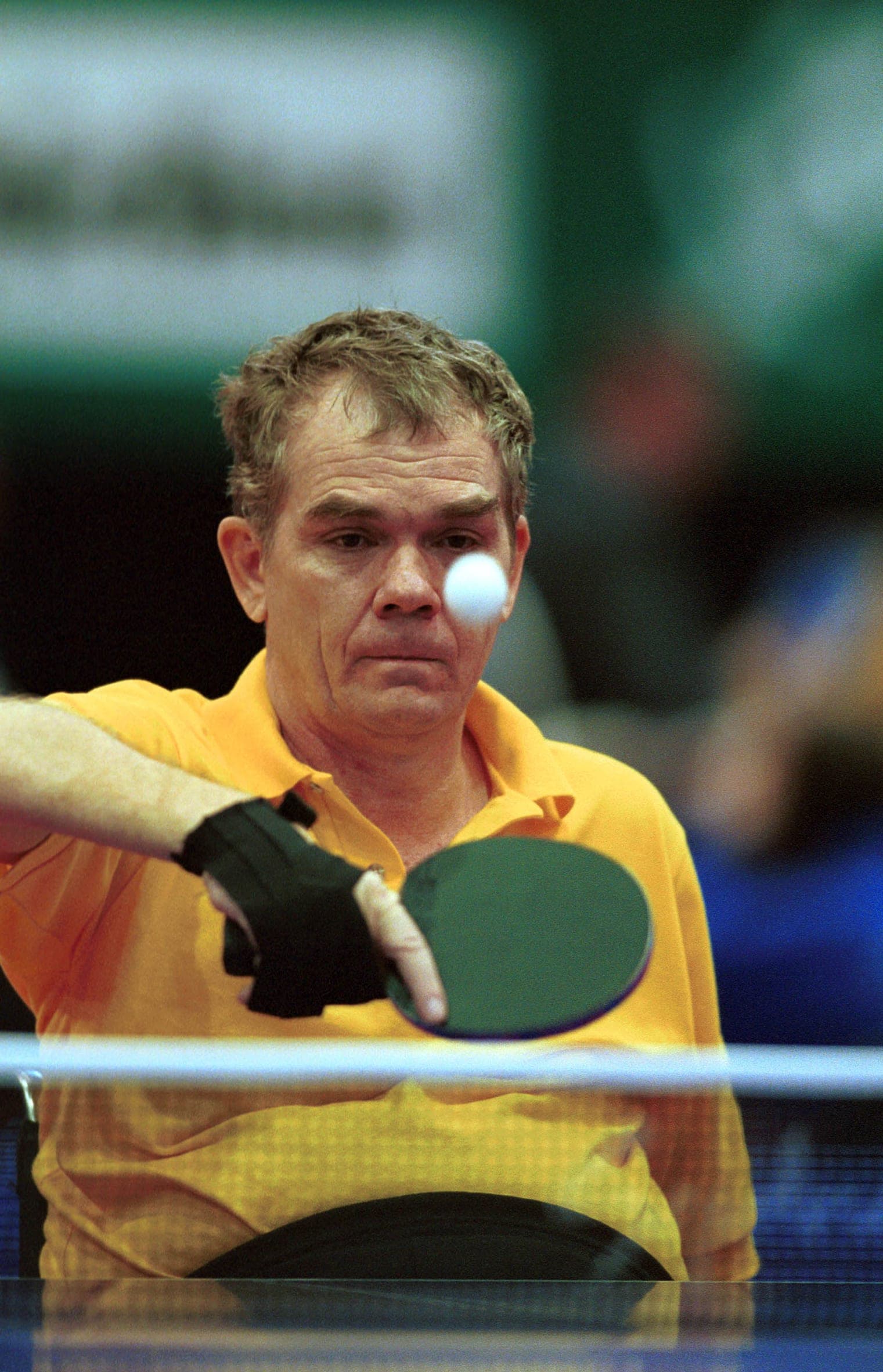
Related techniques
Table Tennis Forehand Drive
A controlled attacking stroke in table tennis, played on the forehand side with a compact swing and light topspin.
Table tennis serve technique
How to serve legally and still create an advantage — generating spin within the rules, keeping the ball short, and why disguise must come from contact rather than concealment.
The loop and the block
Table tennis's primary attacking stroke and its primary counter — how a loop lifts backspin into topspin, and why a block uses the attacker's own pace against them.
Sources
The rules, dimensions and specifications on this page were read from these documents.
- ITTF Statutes — The Laws of Table Tennis — International Table Tennis Federation, 2026, Law 2.3 — The ball; Law 2.4 — The racket (read 2026-09-12)
How it connects
The meaning-bearing relationships that place Spin in table tennis in the wider knowledge graph — each one with the reason it exists.
Builds on
Understanding these first makes this one make sense.
Foundation of
These build directly on this one.
Frequently learned together
Taught side by side in the same stage of a learning path.
- Table Tennis Forehand DriveBoth are taught in the “Build your technique” stage of the Table Tennis learning path.
- Table tennis serve techniqueBoth are taught in the “Build your technique” stage of the Table Tennis learning path.
- The loop and the blockBoth are taught in the “Build your technique” stage of the Table Tennis learning path.
- The push and the chopBoth are taught in the “Build your technique” stage of the Table Tennis learning path.
Explore across the knowledge base
Follow the threads that connect Spin in table tennis to the rest of SocialSportHub.
Equipment
- The table tennis ballThe 40 mm plastic ball the modern game is played with — its exact diameter, weight and colour, and the two separate rule changes that people routinely merge into one.
- The racket, blade and rubberWhat the Laws actually regulate about a table tennis bat — the 85% wood rule, the exact thickness limits for pimpled and sandwich rubber, and the pimple density range.
- Table tennis batA small wooden blade covered with rubber used to hit the ball in table tennis.
- The table tennis net assemblyThe net, its posts and its suspension — the one height that governs both the net and the posts, and why that number appears twice in the Laws.
- The padel ballThe padel ball's own specification — diameter, weight, bounce and internal pressure — and the separate altitude ball the rules provide for above 1,000 metres.
Tactics
- Counter-attackWinning the ball and moving forward at speed to attack before the opponent can reorganise their defence.
- Placement and tempo in table tennisWhy where and when you hit the ball beats how hard — the playing elbow, the wide angles, and how taking the ball earlier removes an opponent's time without adding any power.
- Playing spin bowlingWhat a batter actually does against a spinner — using the crease and the feet to change the length, picking the ball from the hand, and the options when the pitch is turning sharply.
- Fast breakPushing the ball up court at speed after a turnover or rebound to score before the defence sets up.
- High pressA football tactic where a team hunts the ball high up the pitch to win it back close to the opponent’s goal.
Decision making
Rules
- Two-bounce ruleA pickleball rule requiring both the serve and the return to bounce once before players may hit the ball out of the air.
- The padel servePadel's underarm serve, set out exactly — the bounce before the strike, the waist-height limit, where the server's feet must be, and the wire-mesh fault that has no tennis equivalent.
- Innings and oversHow a cricket match is structured — what an innings is, why an over is six balls, how the bowling end alternates, and which parts of the structure the Laws fix and which a competition sets.
- Leg before wicket (LBW)Cricket's most argued-about dismissal, set out as the Laws set it out: five conditions that must all be satisfied, and the one clause that changes everything if the batter played a shot.
- Foot faultA serving fault called when the server's foot touches the baseline or court before striking the ball.
Go deeper with Spin in table tennis
Everywhere else on the platform that covers Spin in table tennis — assembled from what actually references it, so nothing here is a dead end.
Learn it
Structured courses and paths on the platform that cover this directly.
Take it away
Open data and the whole-platform view of this subject.
How this page is maintained
- Content type
- Technique
- Provenance
- Tier A — evergreen educational
- Verified external sources
- 0
- Content updated
- 2026-09-12
Evergreen, first-party explanation — it makes no claim that needs an external source. How we handle sources and reviews.