
Placement and tempo in table tennis
Why where and when you hit the ball beats how hard — the playing elbow, the wide angles, and how taking the ball earlier removes an opponent's time without adding any power.
Overview
On a table 2.74 m long, raw speed has limited value: a player standing close to the table has very little distance to cover. What actually creates difficulty is making an opponent move, making them choose, and taking their time away.
The three tactical levers are placement, tempo and spin variation. Only spin requires a special stroke; the other two are available on every ball.
The playing elbow
The crossover point between a player's forehand and backhand — roughly at their playing elbow — is the hardest place on the table to answer. A ball there requires a decision about which stroke to use, and any hesitation costs more than the movement would have.
This is why "hit to the middle" is good advice in a sport where the obvious tactic would seem to be hitting to the corners. The middle is not a gap in coverage; it is a gap in decision-making.
Wide angles cost more than they look
A ball played wide to a corner does not just move the opponent sideways — it also opens the opposite corner for the next ball, because the opponent must recover across the full width of the table while the rally continues.
Alternating wide angles with balls into the elbow is more effective than either on its own. The wide balls create the movement; the elbow ball arrives while the opponent is still recovering and must now also choose a stroke.
Tempo: taking the ball earlier
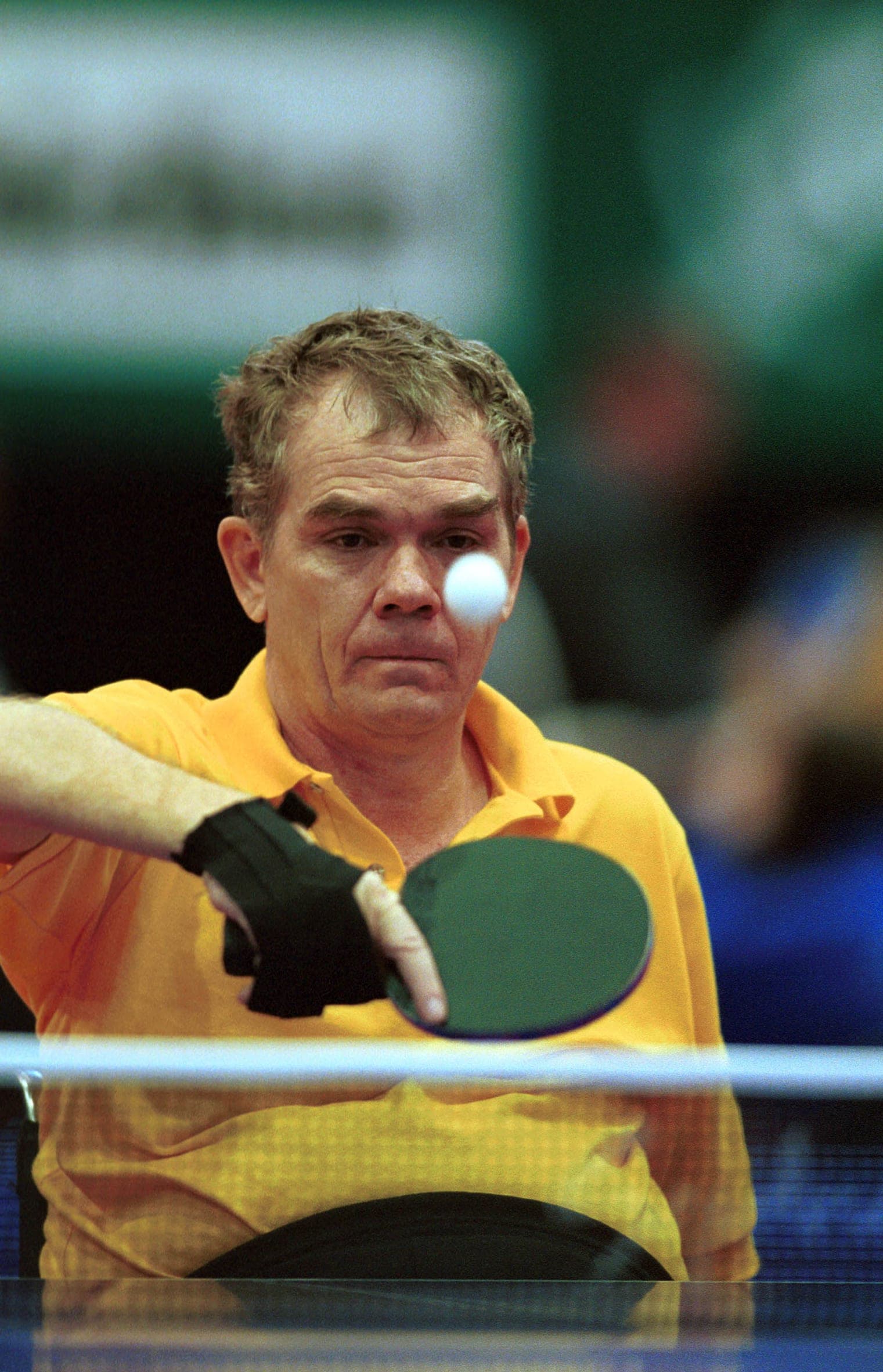
Taking the ball on the rise rather than at the peak returns it sooner, which removes time from the opponent without requiring any extra power. It is the cheapest way to increase pressure in the entire sport.
The trade is control: an earlier contact gives the player less time to read spin and a smaller margin for error. Changing tempo — some balls early, some at the peak — is more disruptive than playing everything early, because it prevents the opponent from settling into a rhythm.
Key points
- On a short table, placement and timing matter more than raw speed.
- The playing elbow forces a decision as well as a movement.
- Wide angles open the opposite corner because the opponent must recover.
- Taking the ball on the rise steals time at no cost in power.
- Varying tempo prevents an opponent from settling into rhythm.
Where it’s used
Sports that use placement and tempo in table tennis:
Sources
The rules, dimensions and specifications on this page were read from these documents.
- ITTF Statutes — The Laws of Table Tennis — International Table Tennis Federation, 2026, Law 2.1 — The table (read 2026-09-12)
How it connects
The meaning-bearing relationships that place Placement and tempo in table tennis in the wider knowledge graph — each one with the reason it exists.
Builds on
Understanding these first makes this one make sense.
Frequently learned together
Taught side by side in the same stage of a learning path.
Used with
Turns up alongside this across the same sports.
Explore across the knowledge base
Follow the threads that connect Placement and tempo in table tennis to the rest of SocialSportHub.
Techniques
- The push and the chopTable tennis's backspin strokes — the short push that stops an opponent attacking, the long push that changes the rally, and the chop that defends from distance.
- The loop and the blockTable tennis's primary attacking stroke and its primary counter — how a loop lifts backspin into topspin, and why a block uses the attacker's own pace against them.
- Spin in table tennisWhy table tennis is a spin sport before it is a speed sport — how topspin, backspin and sidespin change a ball's flight and its bounce off an opponent's bat.
- The return of serveTennis's most under-coached shot — where to stand against a first and second serve, why blocking beats swinging, and what the Rules allow a returner to do.
- Table Tennis Forehand DriveA controlled attacking stroke in table tennis, played on the forehand side with a compact swing and light topspin.
Learning paths
Go deeper with Placement and tempo in table tennis
Everywhere else on the platform that covers Placement and tempo in table tennis — assembled from what actually references it, so nothing here is a dead end.
Learn it
Structured courses and paths on the platform that cover this directly.
How this page is maintained
- Content type
- Tactic
- Provenance
- Tier A — evergreen educational
- Verified external sources
- 0
- Content updated
- 2026-09-01
Evergreen, first-party explanation — it makes no claim that needs an external source. How we handle sources and reviews.