
The racket, blade and rubber
What the Laws actually regulate about a table tennis bat — the 85% wood rule, the exact thickness limits for pimpled and sandwich rubber, and the pimple density range.
Overview
The Laws are permissive about the racket itself and strict about its covering. The racket may be of any size, shape or weight, but the blade must be flat and rigid.
At least 85% of the blade by thickness must be natural wood. An adhesive layer within the blade may be reinforced with fibrous material such as carbon fibre, glass fibre or compressed paper, but must not be thicker than 7.5% of the total thickness or 0.35 mm, whichever is smaller.
Two kinds of rubber, two thickness limits
A side of the blade used for striking the ball must be covered with either ordinary pimpled rubber, pimples outwards, with a total thickness including adhesive of less than 2.05 mm; or sandwich rubber, pimples inwards or outwards, with a total thickness including adhesive of less than 4.05 mm.
Both figures include the adhesive, which is why the limits are quoted to two decimal places. A tolerance may be specified in the relevant technical equipment document.
What each rubber actually is
Ordinary pimpled rubber is a single layer of non-cellular rubber, natural or synthetic, with pimples evenly distributed over its surface at a density of not less than 10 per cm² and not more than 30 per cm².
Sandwich rubber is a single layer of cellular rubber — the sponge — covered with a single outer layer of ordinary pimpled rubber, where the pimpled layer is not more than 2.0 mm thick. The sponge underneath is what gives a modern attacking rubber its speed and its ability to grip the ball for spin.
The two sides must be different colours
Because different rubbers produce radically different amounts of spin, a player who could hide which side they were using would have an enormous concealed advantage. The Laws therefore require the two sides of the racket to be clearly distinguishable by colour.
This is one of the clearest examples in any sport of a rule written purely to preserve information symmetry: the equipment is not restricted, but the opponent must be able to see which of it is being used.
Good to know
- The racket may be any size, shape or weight, but the blade must be flat and rigid.
- At least 85% of the blade by thickness must be natural wood.
- Ordinary pimpled rubber must be under 2.05 mm including adhesive.
- Sandwich rubber must be under 4.05 mm including adhesive.
- Pimple density must be between 10 and 30 per cm².
Where it’s used
Sports that use the racket, blade and rubber:
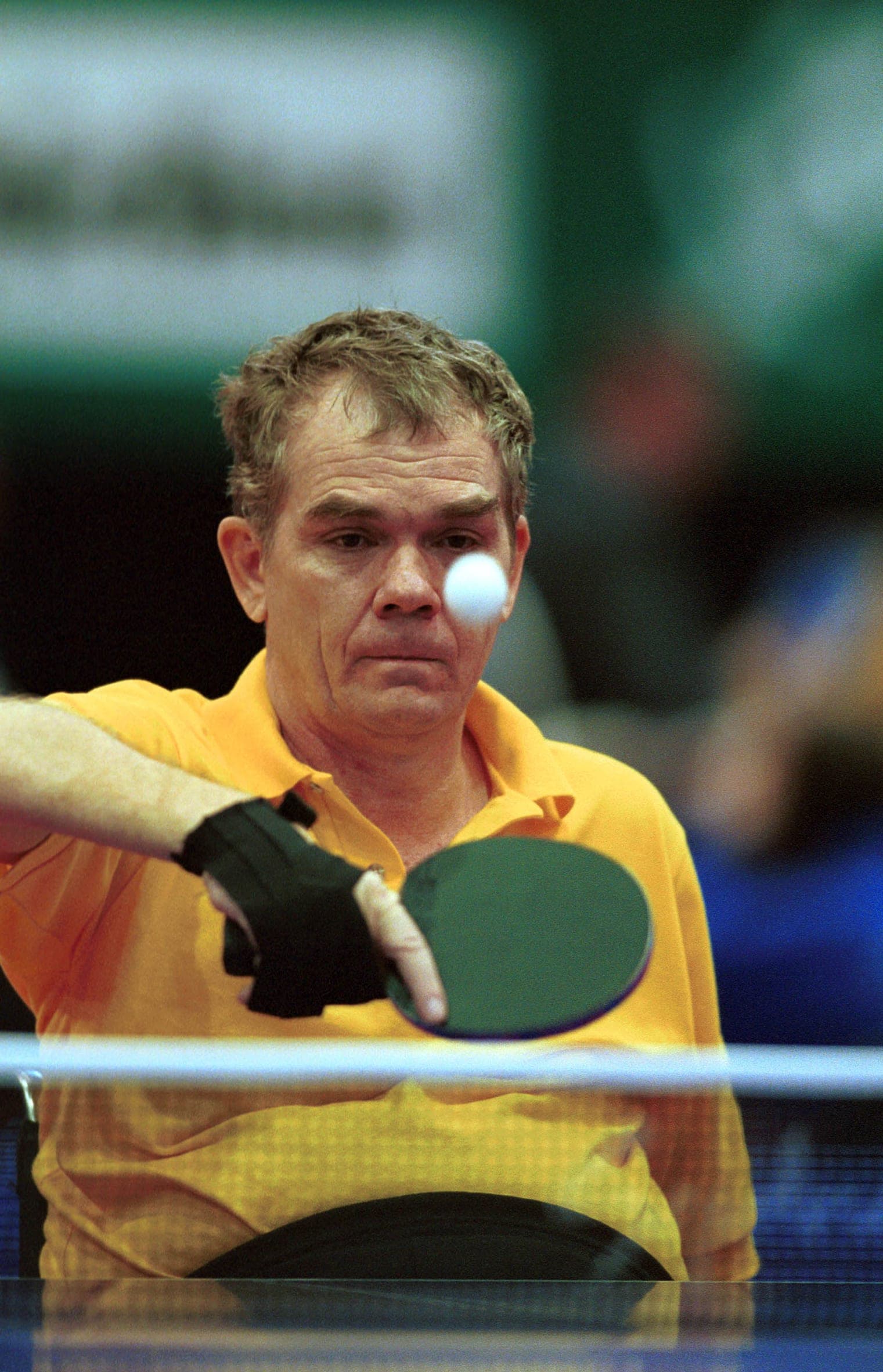
Related equipment
Table tennis bat
A small wooden blade covered with rubber used to hit the ball in table tennis.
The table tennis net assembly
The net, its posts and its suspension — the one height that governs both the net and the posts, and why that number appears twice in the Laws.
The table tennis ball
The 40 mm plastic ball the modern game is played with — its exact diameter, weight and colour, and the two separate rule changes that people routinely merge into one.
Sources
The rules, dimensions and specifications on this page were read from these documents.
- ITTF Statutes — The Laws of Table Tennis — International Table Tennis Federation, 2026, Law 2.4 — The racket (read 2026-09-12)
How it connects
The meaning-bearing relationships that place The racket, blade and rubber in the wider knowledge graph — each one with the reason it exists.
Foundation of
These build directly on this one.
Frequently learned together
Taught side by side in the same stage of a learning path.
- Table tennis batBoth are taught in the “What you’ll need” stage of the Table Tennis learning path.
- The table tennis net assemblyBoth are taught in the “What you’ll need” stage of the Table Tennis learning path.
- The table tennis ballBoth are taught in the “What you’ll need” stage of the Table Tennis learning path.
- The table tennis tableBoth are taught in the “What you’ll need” stage of the Table Tennis learning path.
Used with
Turns up alongside this across the same sports.
Explore across the knowledge base
Follow the threads that connect The racket, blade and rubber to the rest of SocialSportHub.
Rules
- The legal table tennis serveThe most-broken rule in table tennis, set out exactly — the open palm, the 16 cm toss, the no-hiding requirement, and what happens the first time an umpire is unsure.
- LetA call that stops a point and has it replayed without penalty, used across several racket sports.
- No-ballThe illegal delivery in cricket — where the bowler's feet must land, what the Laws say about straightening the arm, and why a no-ball costs a run and has to be bowled again.
- Continuous play and the time between pointsWhat the ITF Rules say about pace of play — 25 seconds between points, 90 seconds at a changeover, 120 at a set break — and why tour rulebooks are a separate document.
- How a point is won in table tennisThe full list of ways a player scores — the returns that fail, the ball through the net, the double hit, the free-hand touch, and the moving-table rule most players never meet.
Officiating
- UmpireA match official who rules on lines, serves and dismissals in racket, bat-and-ball and net sports such as tennis, cricket and baseball — and, in racket sports, also keeps the running score.
- Out-of-Bounds CallAn official's ruling that the ball or a player in possession has left the legal playing area, stopping play and handing a restart or possession to the opponent.
Go deeper with The racket, blade and rubber
Everywhere else on the platform that covers The racket, blade and rubber — assembled from what actually references it, so nothing here is a dead end.
Learn it
Structured courses and paths on the platform that cover this directly.
Take it away
Open data and the whole-platform view of this subject.
How this page is maintained
- Content type
- Equipment
- Provenance
- Tier A — evergreen educational
- Verified external sources
- 0
- Content updated
- 2026-09-01
Evergreen, first-party explanation — it makes no claim that needs an external source. How we handle sources and reviews.