
Tennis court
A rectangular marked court, divided across the middle by a net, where tennis is played as singles or doubles.
Overview
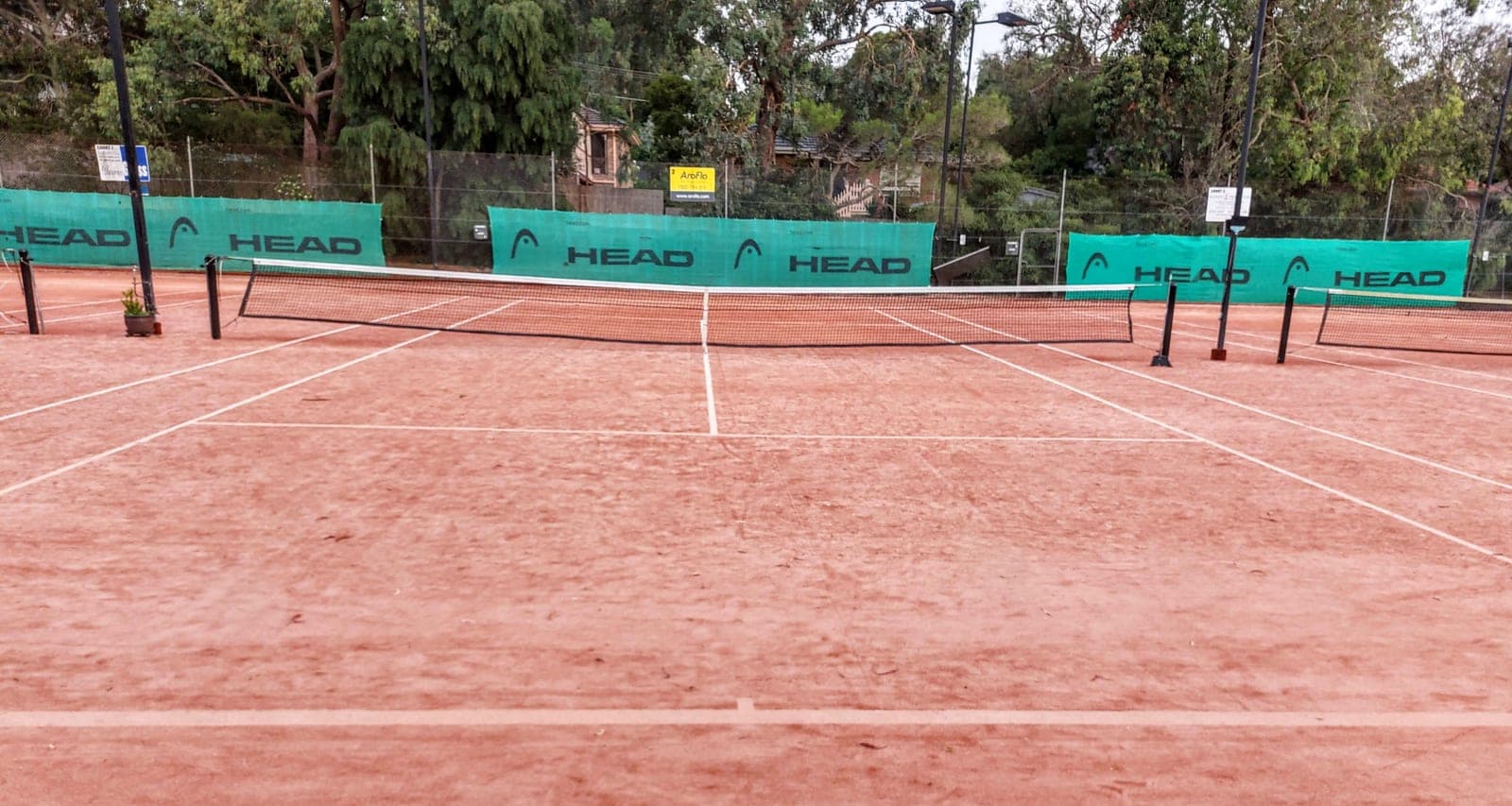
A tennis court is a rectangular playing area split into two halves by a net. Painted lines mark the singles and doubles boundaries, the service boxes and the baselines that define where serves and rallies are played.
Courts are built on different surfaces — hard, clay, grass and artificial — and each changes the speed and bounce of the ball, which is why the same players can look very different from one surface to another.
Good to know
- The doubles court is wider than the singles court, adding a tramline down each side.
- The service boxes sit between the net and the service line; a serve must land in the box diagonally opposite.
- Clay tends to slow the ball and give a higher bounce, while grass and fast hard courts play quicker.
- The same court is used for singles and doubles, with different outer lines counting as in.
Where it’s used
Sports that use tennis court:

Explore across the knowledge base
Follow the threads that connect Tennis court to the rest of SocialSportHub.
Playing surfaces
- Hard courtA rigid acrylic, concrete or asphalt court that gives a true, consistent, medium-paced bounce — the standard multi-use outdoor surface.
- GrassNatural turf grown on soil — the traditional surface for many field sports and, in tennis, a fast court with a low, skiddy bounce.
- ClayA soft, granular racquet-sport surface of crushed brick, stone or shale that slows the ball, gives a high bounce and lets players slide into shots.
Techniques
- Topspin ForehandA forehand groundstroke hit with a low-to-high swing that puts forward spin on the ball so it dips and kicks up on landing.
- One-Handed BackhandA backhand groundstroke struck with a single hand on the grip, driving through the ball with a full extension of the hitting arm.
- Tennis ServeThe overhead stroke that starts every point, hit from behind the baseline into the diagonally opposite service box.
- VolleyA shot played near the net by blocking the ball out of the air before it bounces, using a short, firm punch rather than a full swing.
- The slice in tennisThe underspin stroke that changes a rally's height and pace — how slice keeps the ball low, when it is defensive and when it is an attack, and what it does on different surfaces.
Learning paths
Beginner guides
- Your First Tennis Session: What to ExpectA friendly, honest look at what actually happens at your first tennis session — how it is usually run, what tends to surprise beginners, and how to turn up relaxed and ready to enjoy it.
- Your First Padel SessionA warm, honest look at what your very first padel session actually involves — the doubles court, the walls, and the easygoing rallying that makes it so welcoming to newcomers.
Equipment
- The tennis net, posts and singles sticksThe net's two heights and the hardware that holds them — post height and position, the singles sticks that convert a doubles net, and the strap and band that finish it.
- The padel netThe net that divides a padel court — its two different heights, the maximum post height, the white strip that tops it, and why the posts sit at the lateral limits.
- Road bikeA lightweight bicycle built for speed and efficiency on paved surfaces.
- The goal and the creaseThe net a hockey team defends and the protected area in front of it — the exact goal dimensions, what the crease area includes, and why goaltender contact so often disallows a goal.
How this page is maintained
- Content type
- Facility
- Provenance
- Tier A — evergreen educational
- Verified external sources
- 0
- Content updated
- 2026-09-12
Evergreen, first-party explanation — it makes no claim that needs an external source. How we handle sources and reviews.