
The cricket pitch
The 22-yard strip at the centre of a cricket field where the bowling and batting happen — its exact dimensions, how it is bounded, and who decides whether it is fit to play on.
Overview
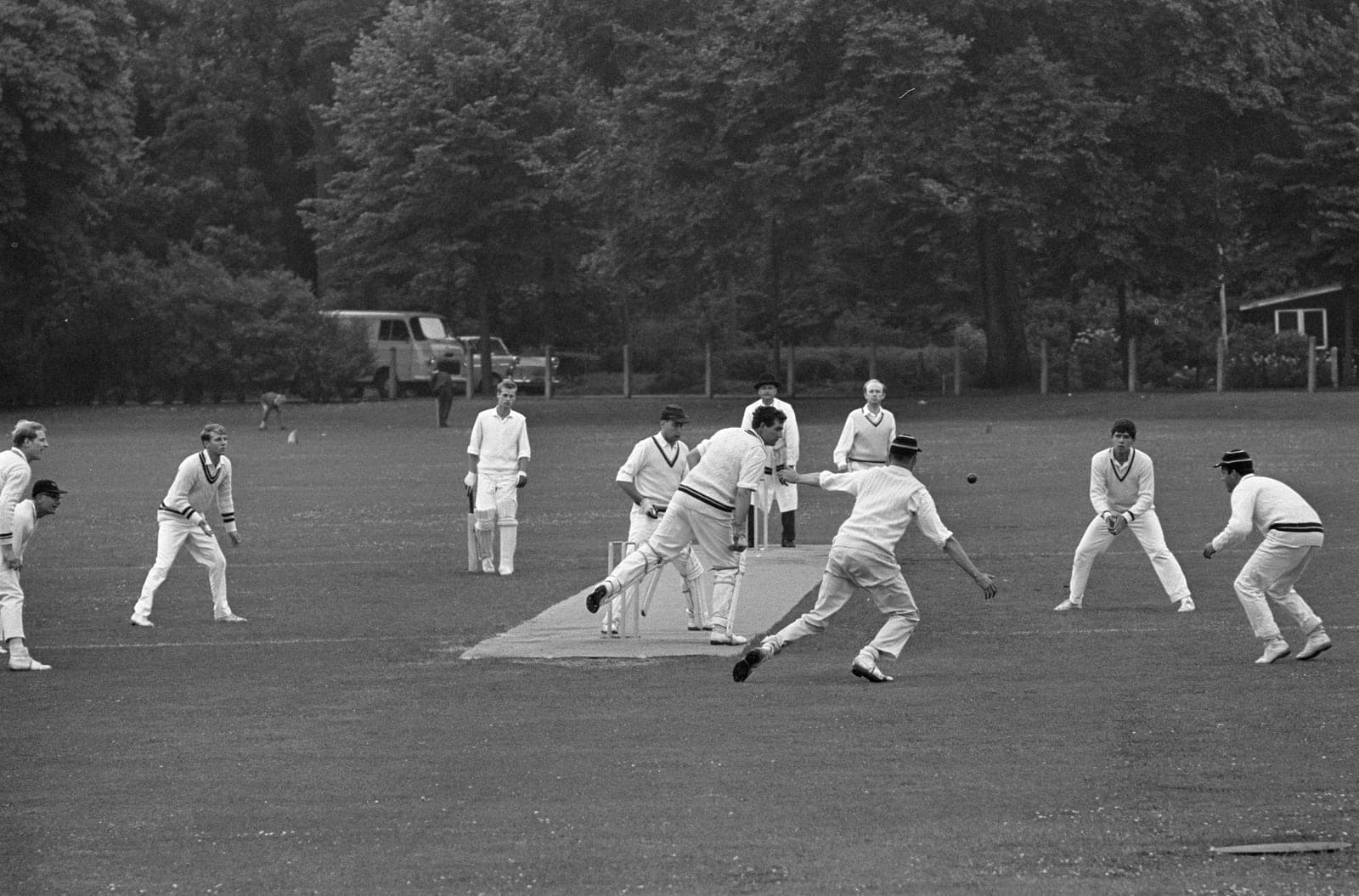
The pitch is the rectangle of prepared ground in the middle of the field, with a set of stumps at each end. Everything that decides a cricket match — the delivery, the stroke, the run-out — happens on or around it. It is the one part of a cricket ground whose size is fixed by the Laws; the rest of the field is not.
Law 6 sets the pitch at 22 yards (20.12 m) long and 10 ft (3.05 m) wide. The length runs from bowling crease to bowling crease. The width is bounded by two imaginary lines 5 ft (1.52 m) either side of the line joining the centres of the two middle stumps — so the pitch is centred on the stumps, not merely near them.
Why 22 yards is a length and not a distance between stumps
The 22 yards is measured between the bowling creases, and the bowling crease runs through the centres of the stumps. The two sets of stumps are therefore 22 yards apart — but a bowler does not release the ball from the crease, and a batter does not stand on it. The ball is usually released a metre or more in front of the bowling crease and met a metre or so in front of the striker's, so the distance the ball actually travels in flight is shorter than the pitch.
That is why the pitch length is a poor guide to how much time a batter has. Reaction time depends on release point, pace and the length the ball is pitched at, not on the 22 yards alone.
Artificial pitches and junior cricket
The Laws recognise that not every pitch is turf. A non-turf pitch must be at least 58 ft (17.68 m) long and 6 ft (1.83 m) wide — noticeably shorter and narrower than the turf minimum, because an artificial strip is laid over a prepared area rather than cut from it.
For junior cricket, Law 6 hands pitch length to the individual governing body rather than fixing it. A shorter pitch for younger players is not a departure from the Laws; it is the Laws deferring to the national body that runs the age group.
Who controls the pitch
Before the match the Ground Authority prepares the pitch. Once play is due to start, the umpires control its use and maintenance, and the umpires alone decide whether conditions allow play.
A pitch can be changed mid-match only if both umpires judge it dangerous or unreasonable and both captains consent. That double condition is deliberate: it prevents a side that is struggling from arguing its way onto a fresh surface.
Good to know
- The pitch is 22 yards (20.12 m) long and 10 ft (3.05 m) wide.
- Its width is set by lines 5 ft (1.52 m) either side of the middle-stump-to-middle-stump line, so it is centred on the stumps.
- The length is measured crease to crease, not from where the bowler releases the ball.
- A non-turf pitch may be as small as 58 ft by 6 ft (17.68 m × 1.83 m).
- Junior pitch lengths are set by each governing body, not by the Laws.
Where it’s used
Sports that use the cricket pitch:
Sources
The rules, dimensions and specifications on this page were read from these documents.
- The Laws of Cricket — Marylebone Cricket Club (MCC), 2017 Code, Law 6 — The pitch (read 2026-09-12)
How it connects
The meaning-bearing relationships that place The cricket pitch in the wider knowledge graph — each one with the reason it exists.
Foundation of
These build directly on this one.
Explains
Covers the underlying "why" for these.
Frequently learned together
Taught side by side in the same stage of a learning path.
- Cricket batBoth are taught in the “What you’ll need” stage of the Cricket learning path.
- Wickets, stumps and bailsBoth are taught in the “What you’ll need” stage of the Cricket learning path.
- The cricket ballBoth are taught in the “What you’ll need” stage of the Cricket learning path.
- The cricket field and boundaryBoth are taught in the “What you’ll need” stage of the Cricket learning path.
- Artificial turfBoth are taught in the “What you’ll need” stage of the Cricket learning path.
Explore across the knowledge base
Follow the threads that connect The cricket pitch to the rest of SocialSportHub.
Rules
- Cricket creasesThe white lines marked at each end of a cricket pitch — bowling, popping and return creases — what each one is for, and the exact measurements that decide no-balls, run-outs and stumpings.
- Order of playThe convention that decides who plays next in a golf group — normally the player whose ball is furthest from the hole.
Techniques
- Seam bowlingMovement off the pitch rather than through the air — how landing the ball on its seam deviates it at the bounce, and why seam and swing are different skills that look alike.
- Spin bowlingHow a slow bowler turns the ball — finger spin against wrist spin, off breaks, leg breaks and the deliveries that go the other way, and why flight matters more than turn.
- Cricket batting grip and stanceThe starting position every cricket stroke is built from — how the hands sit on the handle, how the feet and head are set, and what the setup decides before the ball is even bowled.
- Forward and back defenceThe two strokes a batter survives with — the forward defensive and the back defensive — when each is the right choice, and why a defensive stroke is a decision about length rather than intent.
- Pace bowlingWhat fast bowling is actually for — how speed reduces a batter's reaction time, what the short ball and the yorker each achieve, and how a pace attack uses length as its main variable.
Equipment
- Cricket batA flat-fronted wooden bat used by batters to hit the ball in cricket, with a curved back that concentrates weight behind the hitting area.
- Wickets, stumps and bailsThe three stumps and two bails a bowler aims at and a batter defends — their exact height, width and shape, and what the Laws say about when bails may be dispensed with.
- The cricket ballWhat a cricket ball weighs and measures in men's, women's and junior cricket, who controls the ball during a match, and the rules on taking a new ball after 80 overs.
- The padel netThe net that divides a padel court — its two different heights, the maximum post height, the white strip that tops it, and why the posts sit at the lateral limits.
- The puckThe vulcanised rubber disc ice hockey is played with — its exact diameter, thickness and weight under IIHF rules, and the limits on what may be printed on it.
Playing surfaces
Learning paths
Tactics
- Playing spin bowlingWhat a batter actually does against a spinner — using the crease and the feet to change the length, picking the ball from the hand, and the options when the pitch is turning sharply.
- High pressA football tactic where a team hunts the ball high up the pitch to win it back close to the opponent’s goal.
Go deeper with The cricket pitch
Everywhere else on the platform that covers The cricket pitch — assembled from what actually references it, so nothing here is a dead end.
Learn it
Structured courses and paths on the platform that cover this directly.
How this page is maintained
- Content type
- Facility
- Provenance
- Tier A — evergreen educational
- Verified external sources
- 0
- Content updated
- 2026-09-01
Evergreen, first-party explanation — it makes no claim that needs an external source. How we handle sources and reviews.