
Breakdown strategy
The contest that decides most rugby union matches — when to commit players to a ruck and when to leave it, what a jackal is trying to do, and why the counter-ruck is a gamble.
Overview
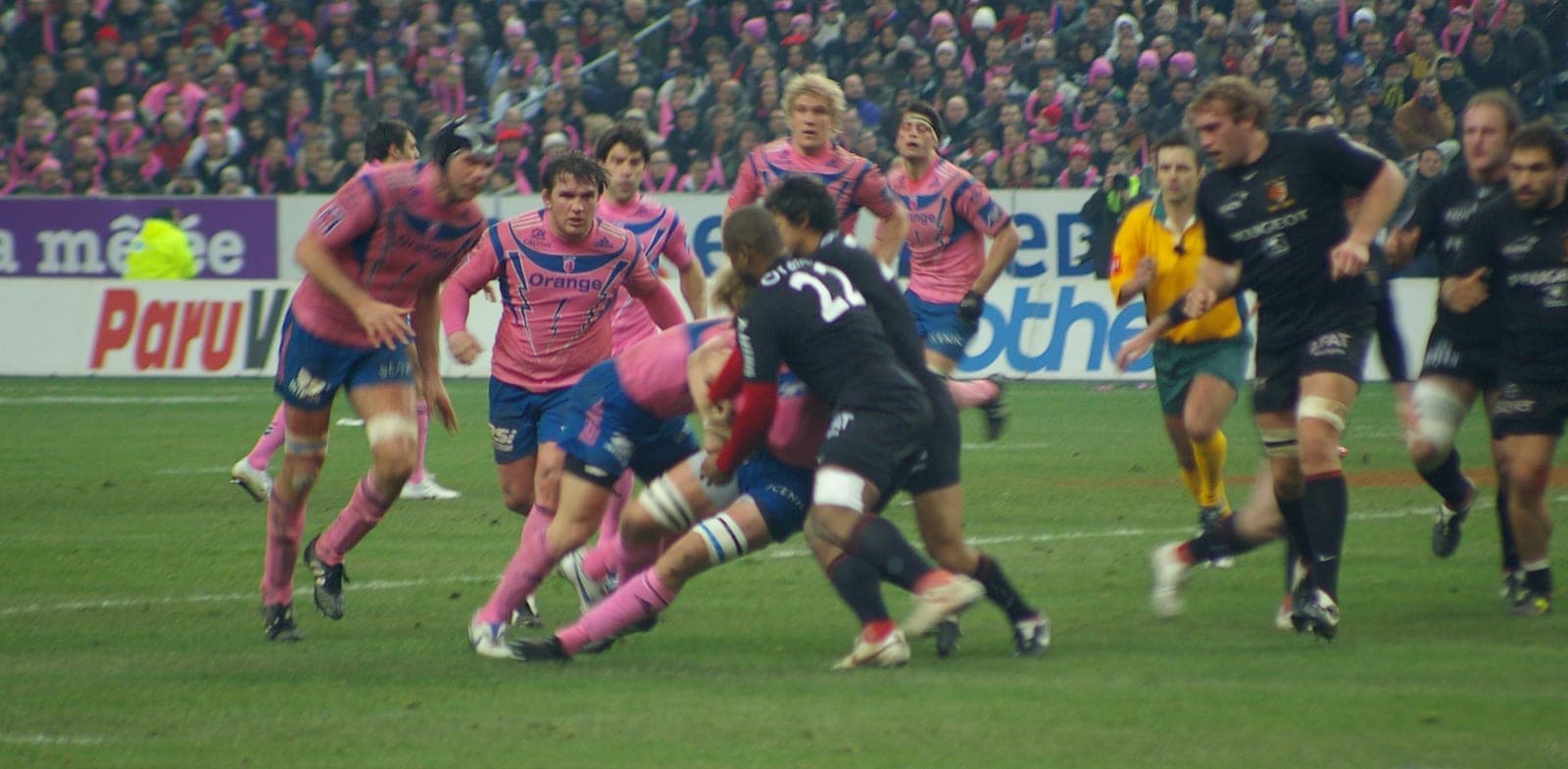
The breakdown is the moment after a tackle when possession is contestable. Deciding how many players to send there, and when, is one of the most consequential tactical choices in rugby union, because every player committed to a ruck is a player not standing in the defensive or attacking line.
Both teams face the same trade. Commit too few and you lose the ball or fail to win it; commit too many and you have won a ruck while being outnumbered everywhere else.
The jackal and the window
A jackal is a defender who arrives at the tackle, stays on their feet over the ball and attempts to win it before a ruck forms. The legal window is narrow: once a ruck has formed, no player may handle the ball unless they already had their hands on it.
So the jackal is racing the formation of the ruck, not the arriving support players. That is the subtlety: a jackal who gets hands on the ball first is legal even when opposition players arrive immediately afterwards, and a jackal who is a fraction late is penalised however strong their position.
Committing to the ruck, or not
An attacking side sends enough players to secure the ball and no more, because everyone else is needed in the attacking line for the next phase. A defending side has a harder choice: contest and risk being penalised or outnumbered, or fold into the defensive line and concede quick ball.
Many defences choose deliberately not to contest most rucks, accepting quick ball in exchange for keeping fifteen defenders in the line. That is a strategy, not a failure to compete.
The counter-ruck
A counter-ruck is a defending side driving over the ball as a bound unit to shove the attacking players off it. Done well it wins the ball outright or forces a turnover; done badly it commits several defenders and leaves a hole in the line.
It is the highest-variance option at the breakdown, which is why teams use it selectively — typically when the attacking side has committed few players, or near their own line where the reward for a turnover is greatest.
Key points
- Every player committed to a breakdown is one fewer in the line.
- A jackal must get hands on the ball before the ruck forms, not before support arrives.
- Attacking sides commit the minimum needed to secure quick ball.
- Choosing not to contest keeps numbers in the defensive line.
- The counter-ruck is high-variance and used selectively.
Where it’s used
Sports that use breakdown strategy:
Related tactics
Set-piece play
Rehearsed routines from a dead-ball situation such as a corner, free kick or throw-in used to create chances.
Territory versus possession
Rugby union's central strategic trade — when to keep the ball and when to kick it away — and why the 22-metre line makes field position worth more than possession in some parts of the field.
Phase play
How rugby union teams attack by keeping the ball through successive rucks — what a phase is, why phases move a defence, and the cost that eventually makes a team stop.
Sources
The rules, dimensions and specifications on this page were read from these documents.
- Laws of the Game: Rugby Union — World Rugby, Law 15 — Ruck; Law 14 — Tackle (read 2026-09-12)
How it connects
The meaning-bearing relationships that place Breakdown strategy in the wider knowledge graph — each one with the reason it exists.
Requires
You need this to make sense of the other one.
Frequently learned together
Taught side by side in the same stage of a learning path.
- Set-piece playBoth are taught in the “Understand tactics & strategy” stage of the Rugby learning path.
- Territory versus possessionBoth are taught in the “Understand tactics & strategy” stage of the Rugby learning path.
- Phase playBoth are taught in the “Understand tactics & strategy” stage of the Rugby learning path.
- Rugby union defensive systemsBoth are taught in the “Understand tactics & strategy” stage of the Rugby learning path.
- Rugby union set-piece strategyBoth are taught in the “Understand tactics & strategy” stage of the Rugby learning path.
Used with
Turns up alongside this across the same sports.
Explore across the knowledge base
Follow the threads that connect Breakdown strategy to the rest of SocialSportHub.
Rules
- The ruckHow a ruck forms in rugby union and what changes the moment it does — the offside line, the ban on handling, the requirement to join from behind, and how a ruck ends.
- The tackleWhat the Laws require of both players in a rugby union tackle — the height limit, the release obligations on the tackler, what the tackled player must do, and how the offside line is created.
- The maulThe contest for a ball held off the ground in rugby union — how a maul differs from a ruck, why that difference changes what players may legally do, and why it is a driving weapon.
- Offside in rugby unionRugby union's most context-dependent law — where the offside line sits in open play, what an offside player must not do, the 10-metre rule after a kick, and how a player is put onside.
- Out-of-court play in padelThe rule that lets a padel player leave the court to keep a rally alive — when it is authorised, what the court must provide for it, and why it depends on the safety area.
Learning paths
Positions
- Rugby union forwardsThe eight players who contest the set piece — front row, locks and back row — what each unit does at scrum, lineout and breakdown, and why the roles are so specialised.
- Rugby union backsThe seven players who attack the space the forwards create — scrum-half, fly-half, centres, wings and fullback — what each does in attack and defence, and how the line is organised.
Sports communication
Go deeper with Breakdown strategy
Everywhere else on the platform that covers Breakdown strategy — assembled from what actually references it, so nothing here is a dead end.
Learn it
Structured courses and paths on the platform that cover this directly.
How this page is maintained
- Content type
- Tactic
- Provenance
- Tier A — evergreen educational
- Verified external sources
- 0
- Content updated
- 2026-09-01
Evergreen, first-party explanation — it makes no claim that needs an external source. How we handle sources and reviews.