
The tackle
What the Laws require of both players in a rugby union tackle — the height limit, the release obligations on the tackler, what the tackled player must do, and how the offside line is created.
Overview
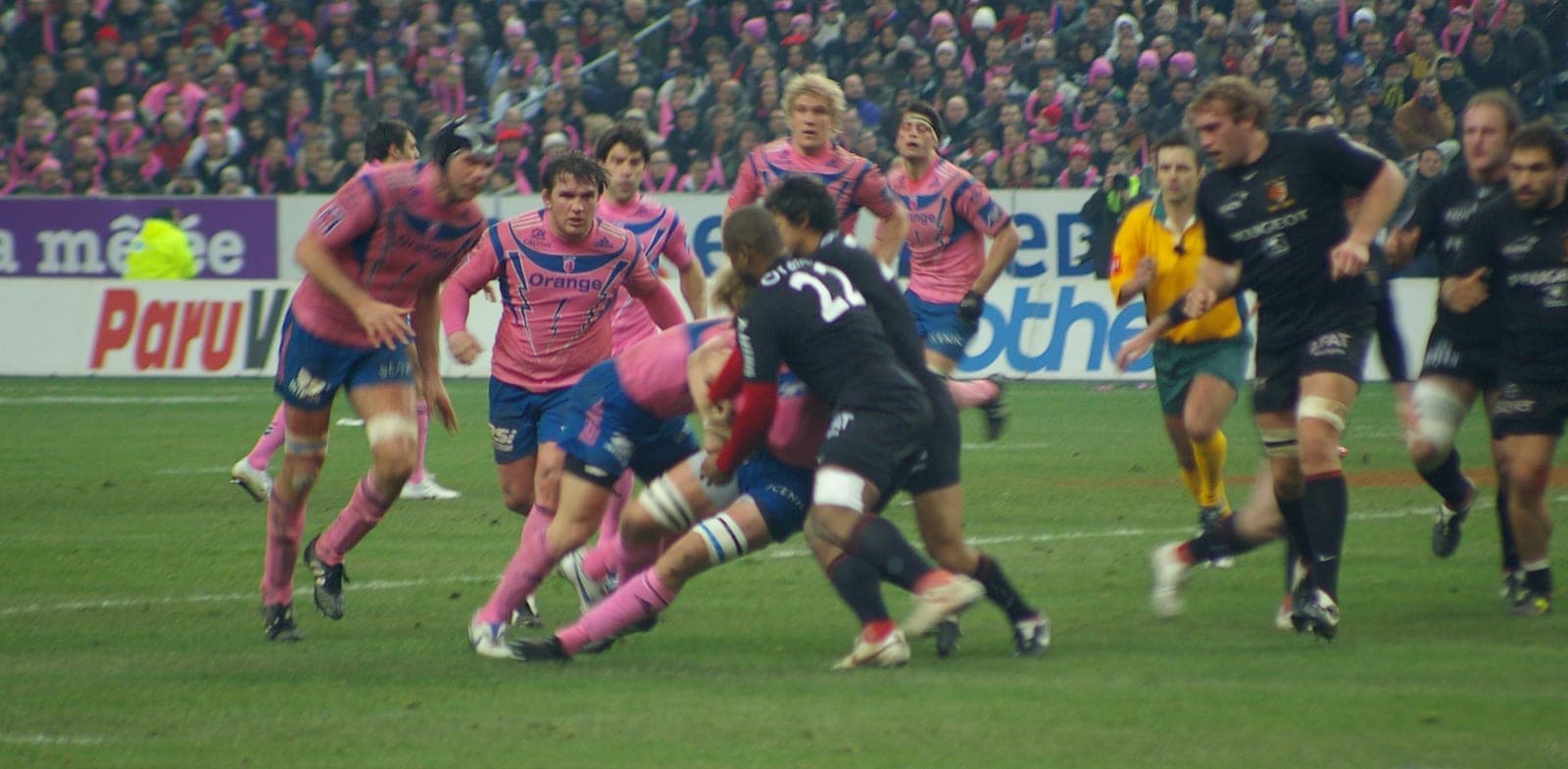
A tackle occurs when the ball-carrier is held and brought to ground by one or more opponents. Being brought to ground means lying, sitting, or having at least one knee on the ground.
The tackle is the moment the ball becomes contestable, and the Laws put strict obligations on both players precisely because whoever ignores them gains an unfair advantage over an opponent who cannot yet compete.
What the tackler must do
The tackler must tackle below the relevant high-tackle sanction line. They must immediately release both the ball and the ball-carrier once both players have gone to ground, and must immediately move away from the tackled player and the ball, or get up.
Before attempting to play the ball they must be on their feet. They must allow the tackled player to release or play the ball and to move away from it. Every one of these carries a penalty sanction.
What the tackled player must do
The tackled player must immediately make the ball available so play can continue — releasing, passing or pushing it in any direction except forward. They must move away from the ball or get up, and must not lie on, over or near the ball to prevent opponents from gaining possession.
The symmetry is deliberate. Neither player is allowed to use the ground as a way of keeping the ball away from a contest, which is what makes the post-tackle situation a genuine competition rather than a reset.
The offside line the tackle creates
Offside lines are created at a tackle when at least one player is on their feet and over the ball while it is on the ground. Each team's line runs parallel to the try line through the hindmost point of any player in the tackle.
This is also the moment a tackle can become a ruck. The distinction matters because once a ruck has formed, the ball may no longer be handled — a limitation that does not apply at a tackle where no ruck has formed.
Why the height rule varies by level
World Rugby sets the high-tackle sanction line at the shoulder in elite rugby and at the waist or base of the sternum in community rugby. The Law is the same; the line it refers to is not.
This is a genuine case where quoting a single legal tackle height would be wrong. A tackle that is legal in a professional match may be penalised in a community one played under the same Law.
Key points
- A tackle requires the ball-carrier to be held AND brought to ground.
- The tackler must release both ball and player, then get to their feet before playing the ball.
- The tackled player must make the ball available immediately and not lie over it.
- Offside lines form once a player is on their feet over the ball.
- The legal tackle height differs between elite and community rugby.
Where it’s used
Sports that use the tackle:
Related rules
Offside
A rule that prevents an attacker from gaining an advantage by being positioned too close to the opponents' goal ahead of the ball and the last defenders.
Yellow and red cards
The disciplinary cards a football referee shows to caution or send off a player for misconduct.
Offside in rugby union
Rugby union's most context-dependent law — where the offside line sits in open play, what an offside player must not do, the 10-metre rule after a kick, and how a player is put onside.
Sources
The rules, dimensions and specifications on this page were read from these documents.
- Laws of the Game: Rugby Union — World Rugby, Law 14 — Tackle (read 2026-09-12)
How it connects
The meaning-bearing relationships that place The tackle in the wider knowledge graph — each one with the reason it exists.
Foundation of
These build directly on this one.
Explained by
The underlying "why" behind this.
Frequently learned together
Taught side by side in the same stage of a learning path.
- OffsideBoth are taught in the “Get to know the game” stage of the Rugby learning path.
- Yellow and red cardsBoth are taught in the “Get to know the game” stage of the Rugby learning path.
- Offside in rugby unionBoth are taught in the “Get to know the game” stage of the Rugby learning path.
- The ruckBoth are taught in the “Get to know the game” stage of the Rugby learning path.
- The maulBoth are taught in the “Get to know the game” stage of the Rugby learning path.
Explore across the knowledge base
Follow the threads that connect The tackle to the rest of SocialSportHub.
Techniques
- Rugby union tackling techniqueHow a tackle is made safely and legally — where to place the head and shoulder, the height the Laws require, and why technique is a safety question before it is a performance one.
- Kicking in rugby unionThe kicks rugby union is played with — punt, grubber, box kick, up-and-under, drop kick and place kick — what each achieves and which law governs its use.
- Rugby union passingHow a rugby pass is actually made — the sideways swing that replaces a throw, why every pass must travel backwards, and what separates a spiral pass from a pop.
Tactics
- Breakdown strategyThe contest that decides most rugby union matches — when to commit players to a ruck and when to leave it, what a jackal is trying to do, and why the counter-ruck is a gamble.
- Offside trapA defensive football tactic where the back line steps up together to leave an attacker offside.
- Territory versus possessionRugby union's central strategic trade — when to keep the ball and when to kick it away — and why the 22-metre line makes field position worth more than possession in some parts of the field.
- Rugby union defensive systemsHow a rugby union defence organises fifteen players across the width of the field — the drift, the blitz and the umbrella — and the specific weakness each system accepts.
Learning paths
Facilities
- The rugby union fieldThe dimensions and markings of a rugby union pitch — the field of play, the in-goal areas, the 22-metre and 10-metre lines, the goal posts, and what the Laws fix versus what they leave open.
- Padel court dimensionsThe exact size and markings of a padel court under FIP rules — the 10 by 20 metre rectangle, the service lines, the line width, and the free height the rules require above it.
- The table tennis tableThe exact dimensions of a table tennis table and its markings — length, width, height, the bounce test the surface must pass, and the lines that only matter in doubles.
Equipment
- The table tennis net assemblyThe net, its posts and its suspension — the one height that governs both the net and the posts, and why that number appears twice in the Laws.
- The rugby union ballThe oval ball that shapes how rugby union is passed and kicked — its weight, air pressure, construction and the provision that lets younger players use a smaller one.
Go deeper with The tackle
Everywhere else on the platform that covers The tackle — assembled from what actually references it, so nothing here is a dead end.
Learn it
Structured courses and paths on the platform that cover this directly.
Take it away
Open data and the whole-platform view of this subject.
How this page is maintained
- Content type
- Rule
- Provenance
- Tier A — evergreen educational
- Verified external sources
- 0
- Content updated
- 2026-09-01
Evergreen, first-party explanation — it makes no claim that needs an external source. How we handle sources and reviews.