
Padel court dimensions
The exact size and markings of a padel court under FIP rules — the 10 by 20 metre rectangle, the service lines, the line width, and the free height the rules require above it.
Overview
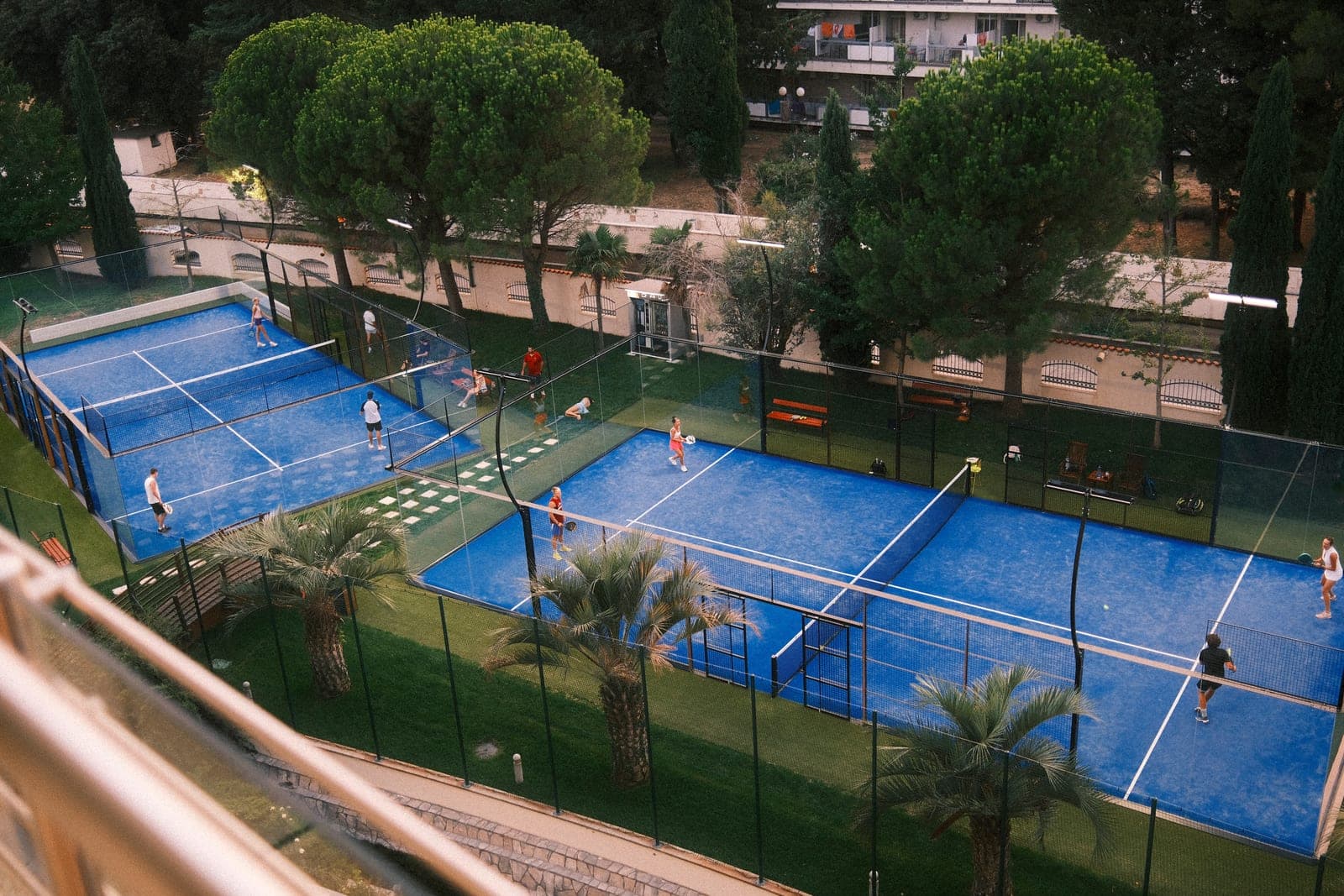
A padel court is a rectangle 10 metres wide by 20 metres long, measured on the interior, with a 0.5% tolerance. It is divided in half by a net, and each half is marked for service.
On either side of the net and parallel to it, at a distance of 6.95 m, are the service lines. The area between the net and each service line is divided in half by a perpendicular central service line, which extends at least 20 cm beyond the service line.
Symmetry and line width
The rules require the two halves of the court to be absolutely symmetrical in surface and line layout. All lines must be 5 cm wide, preferably white or black for contrast with the floor surface.
The 20 cm extension of the central service line beyond the service line is easy to overlook and is there for a practical reason: it gives the server and the umpire a visible reference for the imaginary prolongation of that line, which the serving rules refer to.
Height above the court
Minimum free height must be 6 metres throughout the court, with no elements such as spotlights obstructing that area. For new facilities the rules suggest a minimum free height of 8 metres, again unobstructed.
This matters because the lob is a central tactic in padel. A court with insufficient height above it changes which shots are playable, which is why the free height is specified as a court requirement rather than a venue preference.
Good to know
- A padel court is 10 m by 20 m measured on the interior, with a 0.5% tolerance.
- Service lines sit 6.95 m from the net on each side.
- All lines are 5 cm wide and the two halves must be absolutely symmetrical.
- The central service line extends at least 20 cm past the service line.
- Minimum free height is 6 m, unobstructed, throughout the court.
Where it’s used
Sports that use padel court dimensions:
Related facilities
Padel court
An enclosed court, much smaller than a tennis court, walled with glass and mesh so the ball can be played off the walls.
Padel walls and enclosure
The feature that makes padel its own sport — the glass and mesh enclosure, the two permitted side-wall layouts, and why the wall material is specified by how the ball bounces off it.
Sources
The rules, dimensions and specifications on this page were read from these documents.
- Rules of Padel — International Padel Federation (FIP), application review 01.01.2026, The Court — Dimensions (read 2026-09-12)
How it connects
The meaning-bearing relationships that place Padel court dimensions in the wider knowledge graph — each one with the reason it exists.
Foundation of
These build directly on this one.
Frequently learned together
Taught side by side in the same stage of a learning path.
- Padel racketBoth are taught in the “What you’ll need” stage of the Padel learning path.
- The padel netBoth are taught in the “What you’ll need” stage of the Padel learning path.
- The padel ballBoth are taught in the “What you’ll need” stage of the Padel learning path.
- The padel racketBoth are taught in the “What you’ll need” stage of the Padel learning path.
- Padel courtBoth are taught in the “What you’ll need” stage of the Padel learning path.
Used with
Turns up alongside this across the same sports.
Explore across the knowledge base
Follow the threads that connect Padel court dimensions to the rest of SocialSportHub.
Equipment
- The padel netThe net that divides a padel court — its two different heights, the maximum post height, the white strip that tops it, and why the posts sit at the lateral limits.
- Padel racketA solid, stringless racket perforated with holes, used to play padel. The lack of strings gives padel its distinctive shorter, flatter shots.
- The padel ballThe padel ball's own specification — diameter, weight, bounce and internal pressure — and the separate altitude ball the rules provide for above 1,000 metres.
- The padel racketWhat the FIP rules fix about a padel racket — the maximum length, width and thickness, the mandatory cord, and the perforation limits that define the hitting surface.
- Wickets, stumps and bailsThe three stumps and two bails a bowler aims at and a batter defends — their exact height, width and shape, and what the Laws say about when bails may be dispensed with.
Rules
- The padel servePadel's underarm serve, set out exactly — the bounce before the strike, the waist-height limit, where the server's feet must be, and the wire-mesh fault that has no tennis equivalent.
- The tackleWhat the Laws require of both players in a rugby union tackle — the height limit, the release obligations on the tackler, what the tackled player must do, and how the offside line is created.
- Badminton serve rulesThe rules for how a badminton serve must be delivered and where it must land.
- The lineoutHow rugby union restarts play after the ball goes into touch — where the lineout forms, how many players it may contain, the throw requirements, lifting, and the 10-metre offside line.
- Cricket creasesThe white lines marked at each end of a cricket pitch — bowling, popping and return creases — what each one is for, and the exact measurements that decide no-balls, run-outs and stumpings.
Learning paths
Go deeper with Padel court dimensions
Everywhere else on the platform that covers Padel court dimensions — assembled from what actually references it, so nothing here is a dead end.
Learn it
Structured courses and paths on the platform that cover this directly.
How this page is maintained
- Content type
- Facility
- Provenance
- Tier A — evergreen educational
- Verified external sources
- 0
- Content updated
- 2026-09-12
Evergreen, first-party explanation — it makes no claim that needs an external source. How we handle sources and reviews.