
Off-side in ice hockey
The rule that stops attackers waiting in the attacking zone — where exactly the blue line is crossed, why skates and not sticks decide it, and what a delayed off-side means.
Overview
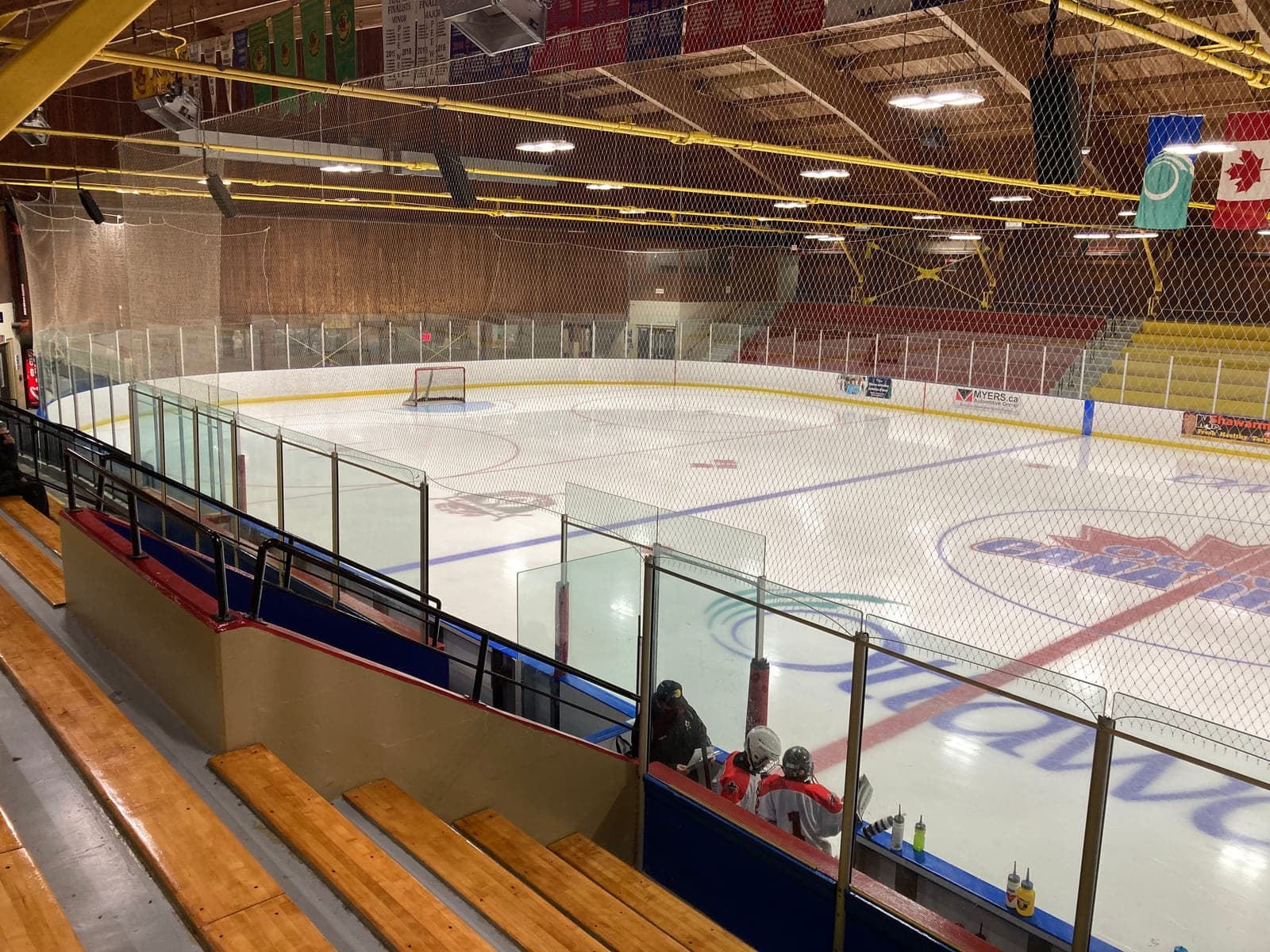
Players of the attacking team must not precede the puck into the attacking zone. The blue line is the boundary, and crossing it ahead of the puck is off-side.
The IIHF rule book is specific about what counts: the position of the player's skates, and not that of their stick, is the determining factor in all instances. A skate here means the blade of the skate only.
Both skates, completely over
A player is off-side when both skates are completely over the leading edge of the blue line involved in the play. A player is on-side when either skate is in contact with the blue line, or on their own side of it, at the instant the puck completely crosses the leading edge.
The blue line is 30 cm wide, so "the leading edge" is a real distinction rather than a technicality. A skate touching any part of that 30 cm band keeps a player on-side.
Breaking the plane
The line extends upwards from the ice, so a raised skate is judged against the vertical plane of the blue line. If a player's skate has yet to break the plane before the puck completely crosses the leading edge, they are on-side.
This is why a player dragging a trailing skate behind them — even in the air — can stay on-side while their body is well into the attacking zone.
The exceptions
A player who controls the puck and crosses the line ahead of it is not off-side, provided they have possession and control. The puck being ahead of the player is the requirement; the player skating it in themselves satisfies it.
During a delayed off-side, an attacking player in the attacking zone may clear the zone via their players' bench, which extends into the attacking zone. They are considered to have cleared when both skates are off the ice and the linesperson judges them to have left the playing surface.
Key points
- Attackers must not precede the puck into the attacking zone.
- Skate position decides off-side; the stick is irrelevant.
- Both skates must be completely over the leading edge for off-side.
- A skate touching any part of the 30 cm blue line keeps a player on-side.
- A player with possession and control may carry the puck in ahead of their body.
Where it’s used
Sports that use off-side in ice hockey:
Related rules
Icing
The rule that stops a team simply firing the puck the length of the ice — what triggers icing, what nullifies it, the goaltender exception, and the line-change penalty that follows.
Ice hockey penalties
How hockey punishes infractions by putting a player in the box — minor, double-minor, major, misconduct and game misconduct — and which ones end early when a goal is scored.
Sources
The rules, dimensions and specifications on this page were read from these documents.
- IIHF Official Rule Book — International Ice Hockey Federation, 2026/27, Off-side (read 2026-09-12)
How it connects
The meaning-bearing relationships that place Off-side in ice hockey in the wider knowledge graph — each one with the reason it exists.
Builds on
Understanding these first makes this one make sense.
Prerequisite of
These need this one first.
Commonly confused with
Close enough to be mixed up — the distinction is worth knowing.
Explore across the knowledge base
Follow the threads that connect Off-side in ice hockey to the rest of SocialSportHub.
Facilities
- The ice hockey rinkThe dimensions and markings of an IIHF ice hockey rink — length, width, corner radius, the blue and centre lines, the goal lines and the face-off circles, with the line widths the rule book specifies.
- Ice rinkA sheet of prepared ice, usually rink-boarded with rounded corners, used for skating and ice sports.
Tactics
- Neutral-zone play and the breakoutThe 15 metres between the blue lines where most hockey possession is decided — how a breakout moves the puck out of the defensive zone, and why zone entries are so contested.
- Offside trapA defensive football tactic where the back line steps up together to leave an attacker offside.
- Zone defenceA defensive system where each player guards an area of the court rather than a specific opponent.
- The penalty killHow a team defends a player short — the box and diamond formations, why killers ice the puck legally, and what a short-handed team is actually trying to protect.
- The forecheckHow a hockey team attacks in the opposition's defensive zone without the puck — the 1-2-2, 2-1-2 and trap approaches, and what each one risks to win the puck back.
Decision making
Techniques
- The push and the chopTable tennis's backspin strokes — the short push that stops an opponent attacking, the long push that changes the rally, and the chop that defends from distance.
- The cricket driveCricket's foundational attacking stroke, played straight down the ground or through the off side — the cover, straight and on drive, and the length that makes each one available.
Go deeper with Off-side in ice hockey
Everywhere else on the platform that covers Off-side in ice hockey — assembled from what actually references it, so nothing here is a dead end.
Take it away
Open data and the whole-platform view of this subject.
How this page is maintained
- Content type
- Rule
- Provenance
- Tier A — evergreen educational
- Verified external sources
- 0
- Content updated
- 2026-09-01
Evergreen, first-party explanation — it makes no claim that needs an external source. How we handle sources and reviews.