
The UCI does not regulate the bicycle for speed. It says so
Cycling's technical regulation is usually read as a fight over marginal gains. Read the governing body's own clarification guide instead and a different rulebook appears — one that regulates the shape of a bicycle to preserve an idea of what a bicycle is, and states that purpose in writing.
The UCI publishes a document whose job is to explain its own technical rules to the people who have to build to them. It is called the Clarification Guide of the UCI Technical Regulation, it runs to eighty pages of diagrams and measuring jigs, and it is the most candid thing in cycling.
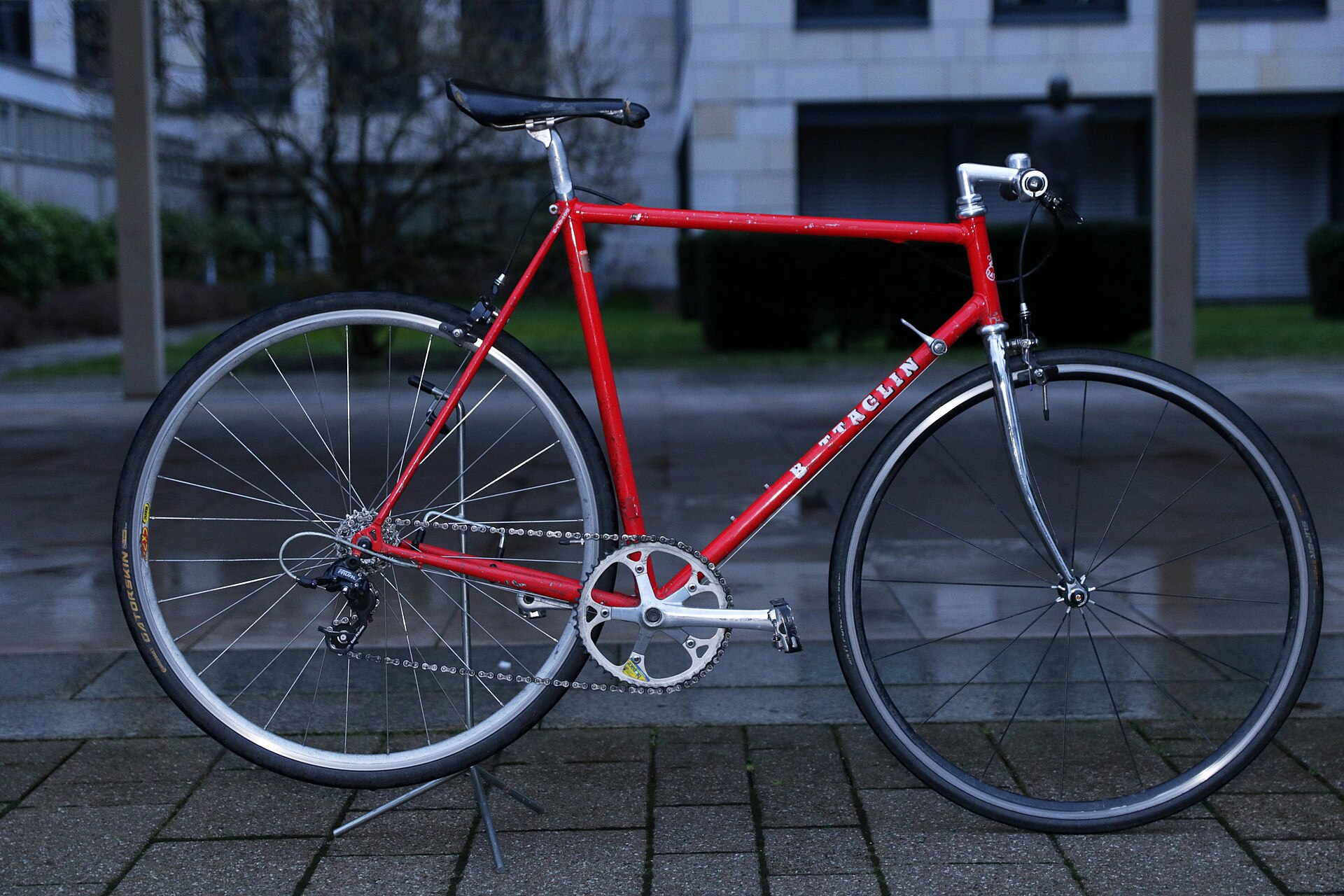
Take Article 1.3.020. The rule reads: for road, track and cyclo-cross competitions, the frame of the bicycle shall be of a traditional pattern, that is, built around a main triangle. The guide then explains how compliance is checked — a design of 80 mm-wide boxes for each tube, with the rear wheel axle required to sit inside the seat-stay and chain-stay boxes and the bottom-bracket axle inside the chain-stay, seat-tube and down-tube boxes.
And then it says why.
This rule results from the Lugano Charter and has the objective of preserving the culture and image of the bicycle as an historical fact. Among other things, it prevents the use of girder frames and bicycles with extravagant shapes that do not represent bicycles as understood by the UCI and which would change the existing disciplines.
Reference The text of Article 1.3.020, the box method for checking the main triangle, and the stated objective of preserving the culture and image of the bicycle as an historical fact, from the clarification guide’s entry on that article.
That is not a safety justification, and it is not a fairness justification. It is an aesthetic and institutional one, written down by the body that enforces it. A frame is illegal because it does not look like a bicycle as understood by the UCI.
Two kinds of rule in one rulebook
Once you have noticed that, the technical regulation sorts itself into two families that behave completely differently.
Rules about shape describe geometry. The saddle’s tip must be positioned behind the vertical plane through the centre of the bottom-bracket spindle axle, and must under no circumstances cross it. The plane through the saddle’s highest front and rear points may sit at most nine degrees from horizontal, and the saddle must be 24 to 30 cm long, with a 5 mm tolerance. Handlebars in most events must be of the traditional type, inside a defined box, with a maximum cross-section of 80 mm on the track and 65 or 80 mm on road and cyclo-cross, a maximum stem cross-section of 80 mm, and a minimum overall width of 400 mm.
Reference The saddle-tip plane rule of Article 1.3.013, the nine-degree and 24–30 cm saddle limits of Article 1.3.014, and the handlebar dimensions of Article 1.3.022.
Every one of those can be settled with a jig and a spirit level. A commissaire does not have to know what the part does. They have to know where it is.
Rules about effect describe consequences. Article 1.3.024 prohibits any device, added or blended into the structure, that is destined to decrease — or which has the effect of decreasing — resistance to air penetration, or artificially to accelerate propulsion: a protective screen, a fuselage-form fairing, or the like. The guide then defines a protective screen as a fixed component serving as a windscreen or windbreak designed to protect another fixed element of the bicycle in order to reduce its wind resistance, and adds that a cover is permitted so long as it only covers an object, without artifice in its shape, content or volume, and never constitutes an excrescence.
Reference The text of Article 1.3.024 and its clarification, including the definition of a protective screen and the conditions under which a cover is authorised.
Notice how much harder that is to apply. “Has the effect of decreasing resistance to air penetration” describes every well-made component on the bicycle. The rule survives only through the qualifiers the guide adds afterwards — is it a screen protecting something else, is the shape artificial, is it an excrescence — and each of those is a judgement rather than a measurement.
Shape rules are cheap to enforce and blunt. Effect rules are precise about what is actually being prevented and expensive to apply. The UCI’s regulation is overwhelmingly the first kind, with a small number of the second kind held in reserve.
The number with no stated reason
Article 1.3.019 is the most argued-about line in the document: the weight of the bicycle cannot be less than 6.8 kilograms.
The guide’s entry on it is entirely procedural. The minimum weight of the bicycle in working order is 6.800 kg, considered without on-board accessories that may be removed during the event. Bottles, on-board computers and all other removable accessories must be taken off for the check. Bottle cages, fixture systems and clipped-on extensions are part of the bicycle and stay in place during the weighing.
Reference The 6.800 kg figure, and the list of what is and is not removed before weighing, from the guide’s entry on Article 1.3.019.
That is a careful, unambiguous procedure. What it does not contain — where the frame rule, the saddle rule and the head-tube rule all contain one — is a sentence explaining what the limit is for. The guide tells a manufacturer precisely how a bicycle will be weighed and says nothing about why 6.8 kilograms is the number.
It is worth being exact about what that does and does not show. A rationale may exist elsewhere in the UCI’s documents; its absence here is not proof that the rule is arbitrary. But the guide’s own habit is to explain, and the omission is conspicuous next to neighbours that volunteer their reasoning unprompted.
The exemption that admits the problem
The most revealing article is the one that lets riders out of the rules.
Positions are constrained by absolute distances: how far behind the bottom bracket the saddle must sit, how far in front of it the extensions may reach. Those distances are the same for every human being. A rider of 1.60 m and a rider of 1.95 m are handed identical limits and asked to find a position inside them.
So the regulation carries exemptions. A rider may apply, for morphological reasons, to advance the handlebar extensions further than the standard limit — to 800, 830 or 850 mm in front of the bottom-bracket centre depending on the category. Only one exemption is allowed per rider.
Reference The morphological exemptions permitting extensions to be advanced to 800, 830 or 850 mm, and the limit of one exemption per rider, from the guide’s summary of authorised positions.
An exemption is an admission. A rule stated in centimetres from a fixed point on the machine cannot be neutral between bodies of different lengths, and the UCI, rather than restate the rule in proportional terms, has built an appeals process on top of it. The guide is equally direct elsewhere about what a dimensional rule is doing: the 160 mm head-tube zone, it says, was introduced to guarantee improved aerodynamic fairness in competition between taller and shorter riders while allowing manufacturers room to keep a design consistent across frame sizes.
Reference The stated purpose of the 160 mm head-tube reinforcement zone — aerodynamic fairness between taller and shorter riders, and consistency of design across frame sizes.
Fairness between body sizes is a real regulatory objective, and it is the reason a shape rule needs an escape hatch. The two clauses are the same problem seen from either end.
Where the rulebook stops writing itself
There is one more thing the guide does that is easy to skim past. For non-standard wheels it does not define a test of its own. It requires compliance with the impact test in ISO 4210-2:2023, Cycles — Safety requirements for bicycles, and conformity with ISO 5775-2 for rims and ISO 5775-1 for tyres, before a wheel can join the list of wheels authorised for competition.
Reference The requirement that non-standard wheels meet the impact test of ISO 4210-2:2023 and comply with ISO 5775-1 and ISO 5775-2 to be listed as authorised for competition, from the guide’s entry on wheels.
That is the only place in this part of the regulation where the UCI hands the question to somebody else, and it is the place where the question is genuinely about safety rather than about shape. When the governing body wants to know whether a wheel will survive an impact, it cites an international standard. When it wants to know whether a frame is a bicycle, it draws boxes and appeals to history.
Both are legitimate ways to write a rule. They are not the same activity, and cycling’s technical regulation is unusual mainly in refusing to pretend otherwise. A sport that regulated only for performance would have no view on whether a frame has a main triangle. This one does, and has written down that the view is about culture rather than about speed.
Read the evergreen pages
This piece is an argument. These are the reference pages on SocialSportHub that document the same subjects.
References
- [1]Union Cycliste InternationaleGoverning body. Clarification Guide of the UCI Technical Regulation, in force from 1 January 2026 — Articles 1.3.013, 1.3.014, 1.3.019, 1.3.020, 1.3.022, 1.3.024. Accessed 6 September 2026.
Continue reading
Editor’s pick
What the middle of the peloton is worth, measured
Cycling has long put the benefit of drafting at somewhere between a third and a half. A study simulating two 121-rider pelotons at nearly three billion cells apiece, checked against four wind-tunnel tests, found that deep inside a packed bunch the figure is not a third. It is a twentieth.
Editor’s pick
Every 250-metre velodrome is a different 250 metres
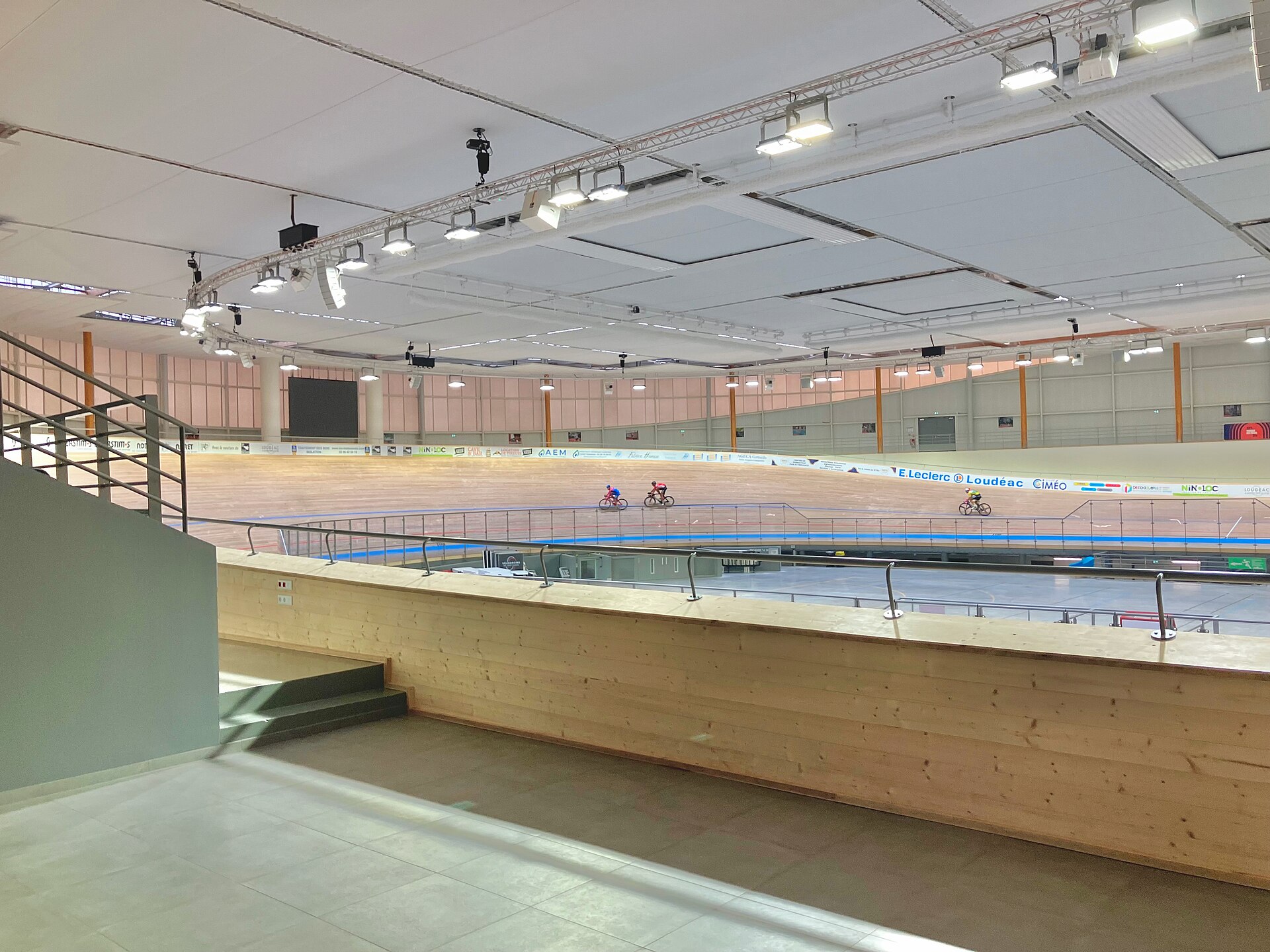
The UCI fixes a track's length, its width, the position of three painted lines and the requirement that any cross-section be straight. It does not fix the banking, does not require the four quadrants to match, and the resulting geometry is often withheld as commercially confidential.
More on cycling
Cycling's sock rule is measured against two bones
The UCI limits how high a sock may rise, and it does not use centimetres. The limit is half the distance between the middle of the lateral malleolus and the middle of the fibula head — a rule stated in anatomy, for a stated reason.