
Every 250-metre velodrome is a different 250 metres
The UCI fixes a track's length, its width, the position of three painted lines and the requirement that any cross-section be straight. It does not fix the banking, does not require the four quadrants to match, and the resulting geometry is often withheld as commercially confidential.
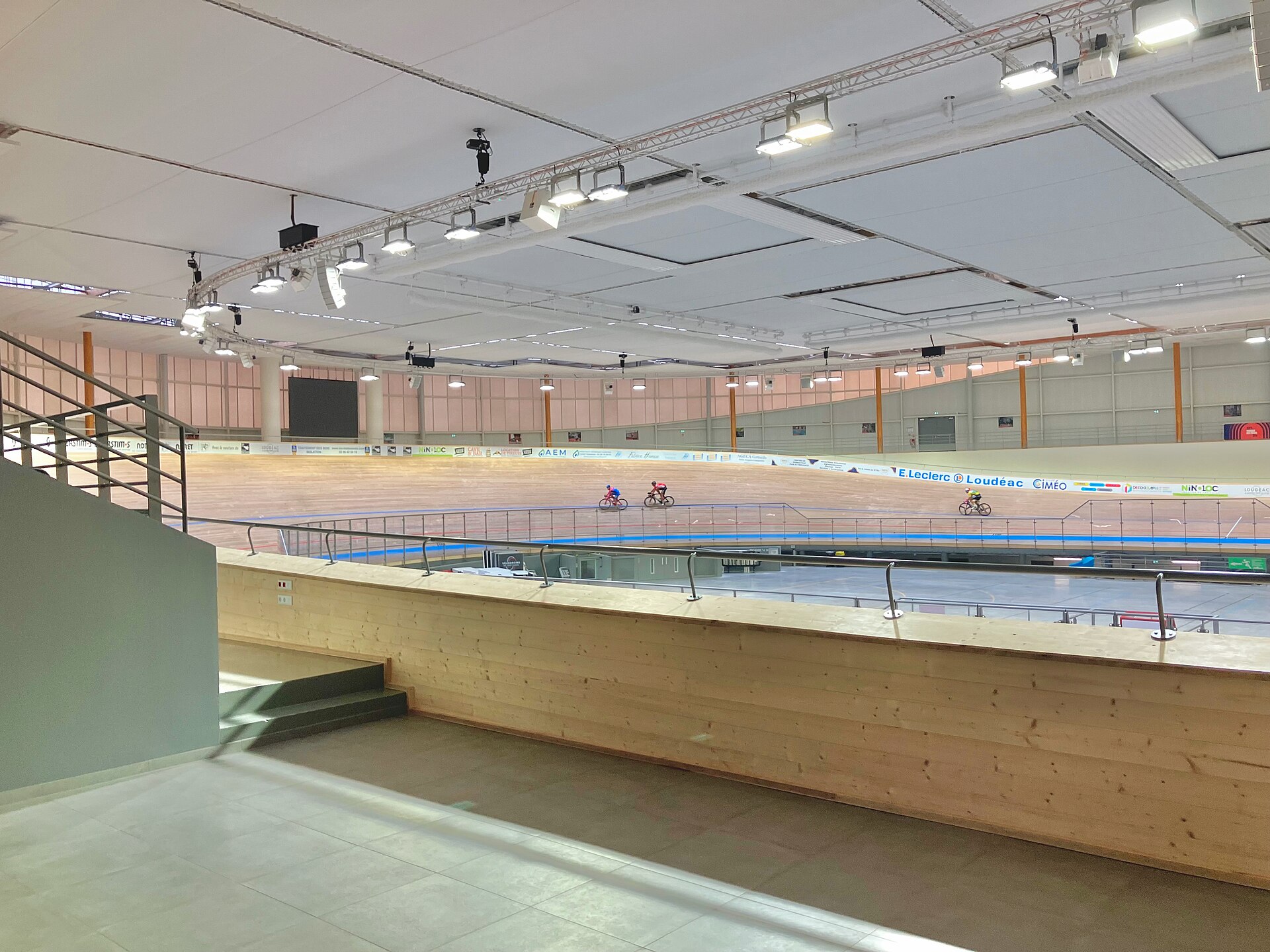
A velodrome looks like the most exactly specified surface in cycling. It is an oval of known length, in a building, with the lines painted on. Riders talk about tracks the way swimmers talk about pools: fast or slow, but fundamentally the same object in different places.
They are not the same object, and the reason is visible in what the UCI’s regulations do and do not say.
What is fixed
Five articles constrain the shape of the track, and they are unambiguous about their subject.
The inner edge, Article 3.6.067 says, shall consist of two curves connected by two parallel straight lines, with the entrance and exit of the bends designed so that the transition is gradual. Article 3.6.068 puts the length between 133 m and 500 m inclusive, and requires 250 m for the World Championships and the Olympic Games. Article 3.6.069 says the length shall be measured 20 cm above the inner edge — the upper edge of the blue band. Article 3.6.070 requires the width to be constant throughout, at a minimum of 7 m for tracks approved in categories 1 and 2. And Article 3.6.073 requires that at any point on the track, a cross-section of the surface must present a straight line.
Reference The text of Articles 3.6.067, 3.6.068, 3.6.069, 3.6.070 and 3.6.073, quoted in an analysis of UCI-regulated track design.
Then the markings. A rideable sky-blue band along the inside edge — the côte d’azur — at least 10 per cent of the width of the track, with the same surface properties as the track itself. Immediately inside it a prepared, marked safety zone, with the band and zone together at least 4 m wide for tracks of 250 m and over and 2.5 m for shorter ones. And three longitudinal lines: the measuring line at 20 cm from the inside edge, measured on its inside edge; the red sprinters’ line; and the blue stayers’ line, at 85 cm and at the greater of a third of the width or 2.45 m.
Reference The blue-band and safety-zone requirements of Articles 3.6.071 and 3.6.072, and the measuring, sprinters’ and stayers’ lines of Articles 3.6.079 to 3.6.081.
That is a lot of specification. It is also, read carefully, specification of everything except the shape of the surface itself.
What is not
Nowhere in those articles is there a banking angle.
The regulation says the cross-section must be a straight line — meaning the track cannot be dished or curved across its width, and a rider crossing from the inside to the outside is riding up a flat ramp rather than a bowl. It does not say how steep that ramp is, at any point on the lap. Banking is a consequence of the designer’s choices about turn radius and transition, not a number the rule supplies.
Nor is the turn radius fixed. For a 250 m track the permitted bend radius runs from 19 m to 25 m and the width from 7 m to 8 m; for a 400 m track the radius runs from 28 m to 50 m.
Reference The radius and width ranges for tracks of 250, 285.714, 333.33 and 400 m, adapted from UCI Article 3.6.095.
Bend radius the UCI permits, by track length
Metres of turn radius — end caps mark the permitted range
The numbers behind this chart
| Row | Metres of turn radius — end caps mark the permitted range | Detail |
|---|---|---|
| 250 m track | 19 to 25 | width 7–8 m |
| 285.714 m track | 22 to 28 | width 7–8 m |
| 333.33 m track | 25 to 35 | width 7–9 m |
| 400 m track | 28 to 50 | width 7–10 m |
Source UCI Regulations, Article 3.6.095, as tabulated in Stanoev, arXiv:2207.13556.
Method Values as tabulated in the cited paper. Both ends of each permitted range are plotted; no midpoint is taken.
Two Olympic-standard tracks, both exactly 250 m when measured 20 cm above the inner edge, may therefore have bends that differ in radius by six metres. A tighter bend at the same speed demands more lateral force, which the designer supplies with more banking. The tracks are the same length and are not the same ride.
The symmetry nobody requires
There is a further freedom, and it is the one that most undermines the idea of a standard track.
Nothing in the articles requires the four quadrants to be alike. A designer may vary the features of each, producing an asymmetric track. The paper gives an example: at the London 2012 Olympic velodrome, the angle of the exit from the banking is steeper than the entry, so that a rider is in effect always riding downhill, catapulted along the straights.
Reference That it is permissible for design features to vary between quadrants, yielding an asymmetric design, and the London 2012 example of a steeper exit than entry.
A track can be built to give something back on the way out of every bend. That is not a loophole; it is what the regulation leaves to design. Length, width, cross-section and line positions are constrained. The relationship between them — where curvature begins, how quickly it grows, how the banking follows — is not.
The measurement that defines the lap
One detail in Article 3.6.069 does more work than its length suggests. The track is measured 20 cm from the inside edge, on the inside edge of the measuring line.
That is the only lap distance that officially exists. A rider on the measuring line covers 250 m; a rider a metre higher covers more, and how much more depends on the radius of the bends — which, as above, is not fixed. The extra distance a rider pays for riding wide is a property of the individual building.
The paper also notes an assumption most performance models make and that the regulation quietly contradicts: because the measuring line sits at a fixed offset from an inner edge that varies in inclination along its length, it is necessarily a three-dimensional curve, not a line in a horizontal plane.
Reference That the measuring line, being at a fixed offset from an inner edge that varies in inclination, is necessarily a three-dimensional curve rather than a plane curve, and that models commonly assume otherwise.
The nominal 250 m is measured along a path that climbs and falls. It is not the length of anything flat.
The part that is not published
Here is the fact that makes velodromes unlike almost every other regulated surface in sport. The specific details of a track’s geometry, the paper observes, are often withheld as confidential and proprietary, with only generic information released publicly — the type of wood, the number of nails, the range of banking angles.
Reference That specific track-geometry details are often withheld as confidential and proprietary, with only generic information such as timber type, nail count and banking range made public, from the paper’s introduction.
The consequence runs through the whole research literature. Because the shapes are not published, researchers have had to build their own models of them, and the paper traces a succession of increasingly elaborate approximations: circular tracks, then two straights joined by semicircles, then theodolite surveys of real buildings, then half-ellipses for the bends. None of the early ones accounted explicitly for the gradual transition between straight and bend that Article 3.6.067 requires — the first to do so came decades into the effort.
Reference The succession of modelling assumptions — circular tracks, two straights joined by semicircles, theodolite measurements, elliptical bends — and the observation that none accounted explicitly for the transition curves until relatively recently, from the paper’s introduction.
A running track’s geometry is public. A swimming pool’s is public. A velodrome’s, in the detail that determines what a lap actually costs, frequently is not, and so a whole branch of sports engineering has spent thirty years reverse-engineering buildings that already exist.
The UCI has specified the track carefully. It has specified the things a commissaire needs to check on the day of a race — is it the right length, are the lines in the right place, is the band wide enough — and left the things that decide how the track rides to the people who build them. For most sports that division would be unremarkable. In a discipline where the surface is the opponent, it means the sport’s most precisely engineered venue is also the one it knows least about.
Read the evergreen pages
This piece is an argument. These are the reference pages on SocialSportHub that document the same subjects.
References
- [1]Theodore Stanoev, arXiv preprint 2207.13556 (physics.pop-ph)University. On technical considerations of UCI-regulated velodrome track design — quoting UCI Regulations Part 3, Chapter VI, Articles 3.6.067–3.6.081. Accessed 6 September 2026.
Continue reading

Editor’s pick
The UCI does not regulate the bicycle for speed. It says so
Cycling's technical regulation is usually read as a fight over marginal gains. Read the governing body's own clarification guide instead and a different rulebook appears — one that regulates the shape of a bicycle to preserve an idea of what a bicycle is, and states that purpose in writing.
Editor’s pick
What the middle of the peloton is worth, measured
Cycling has long put the benefit of drafting at somewhere between a third and a half. A study simulating two 121-rider pelotons at nearly three billion cells apiece, checked against four wind-tunnel tests, found that deep inside a packed bunch the figure is not a third. It is a twentieth.
More on cycling
Cycling's sock rule is measured against two bones
The UCI limits how high a sock may rise, and it does not use centimetres. The limit is half the distance between the middle of the lateral malleolus and the middle of the fibula head — a rule stated in anatomy, for a stated reason.