
The shoe rule never mentions a spring
World Athletics' shoe regulations are read as a limit on how much energy a sole may return. Read the document and the limits are on something else entirely: a thickness at two specified points, the topology of a rigid structure, and whether anyone can buy the shoe.
Search the Athletic Shoe Regulations for the words the public argument is conducted in — spring, energy return, carbon, stiffness, propulsion — and the document does not oblige. What it regulates instead is three things that have very little to do with one another.
One: a thickness, at two points, on one shoe size
The sole thickness limit is not a limit on the shoe. It is a limit on two measurements taken from it.
The thickness is measured at the centre of the forefoot and the centre of the heel, defined as the centre point of the shoe at 75 per cent and at 12 per cent of its internal length. The shoe is placed on a hard flat substrate and the distance is measured from the inside down to that substrate at those two points.
Reference The measurement points at 75 per cent and 12 per cent of internal length, and the procedure of measuring from the inside down to a hard flat substrate, from Regulations 8.3 and 8.4.
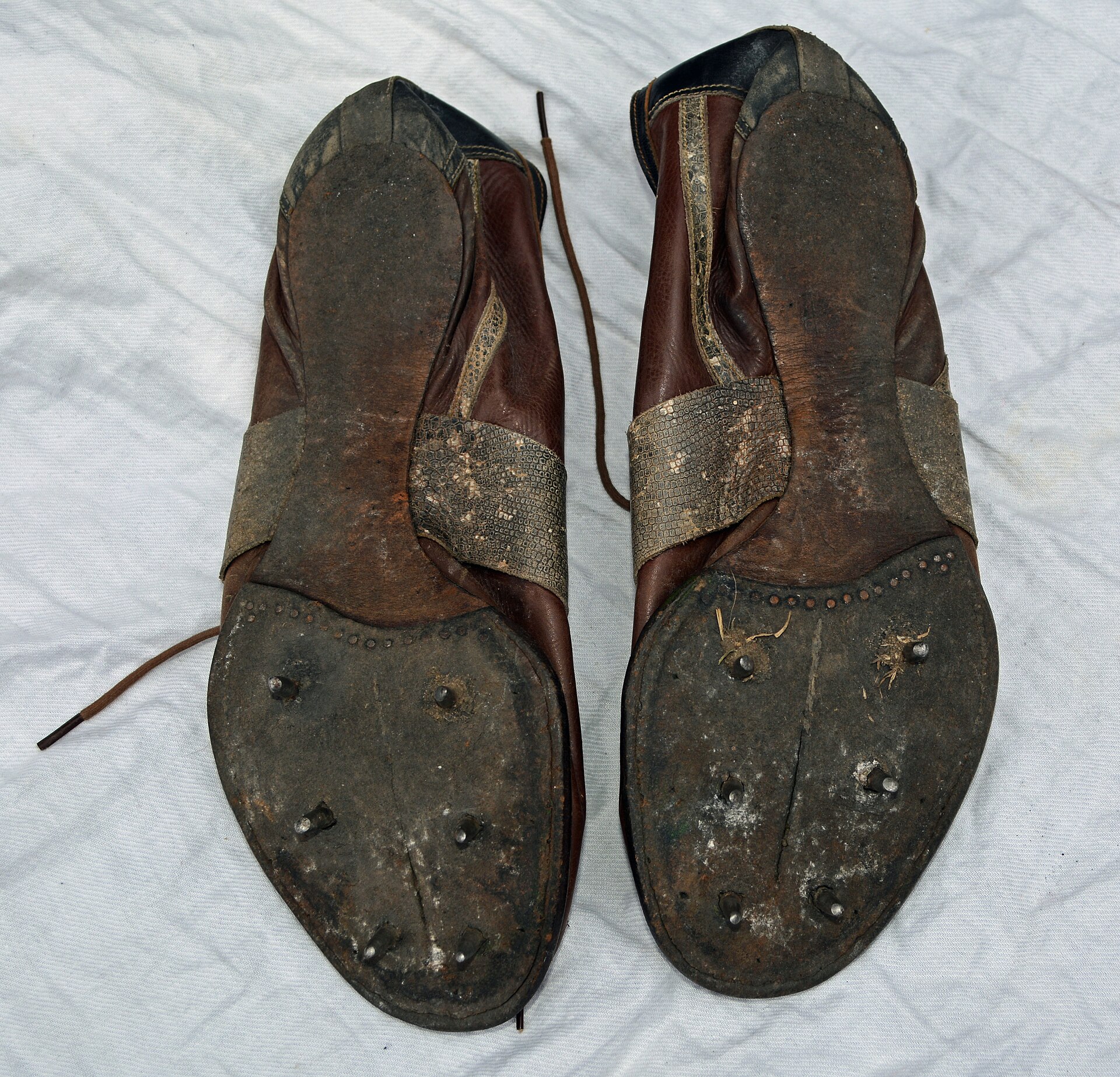
Everything on the sole counts towards it. Grooves, ridges, indentations, protrusions and protuberances are permitted, and where a shoe carries spikes or a traction plate intended for the track, the receptacles designed to hold the spikes, and the protrusions of a traction plate, are included in the definition of the sole and therefore included in the measurement.
Reference That grooves, ridges, indentations, protrusions and protuberances are permitted and that spike receptacles and traction-plate protrusions are included in the sole for measurement purposes, from Regulation 8.2.
And for approval, the measurement is taken on one nominated size: a standard sample with a sole length of 270 mm — US 8.5, EUR 42, UK 8.
Reference The standard sample sole length of 270 mm, equivalent to US 8.5, EUR 42 and UK 8, from Regulation 8.4.1.
That last provision is more consequential than it looks, and the regulations say so. World Athletics acknowledges that a shoe above the standard sample size might contain a marginally thicker sole attributable only to the larger size, and disregards such marginal increases for the purposes of confirming compliance.
Reference The acknowledgement that larger shoes may be marginally thicker for size reasons alone, and that such increases are disregarded, from Regulation 8.4.4.
A rule stated as an absolute in millimetres is being applied to a family of objects that scale with the foot inside them. World Athletics resolves this by nominating a reference size and forgiving the drift — the same solution cycling reaches with morphological exemptions, arrived at from the opposite direction.
There is also a tolerance, and it is proportional: where a shoe is submitted for examination by the Independent Body, a 5 per cent sole-thickness measurement tolerance applies — 1 mm for a 20 mm limit and 2 mm for a 40 mm one.
Reference The 5 per cent measurement tolerance and its worked values of 1 mm for 20 mm and 2 mm for 40 mm, from Regulation 8.4.2.
The limits are not one number
The much-quoted 40 mm applies to a narrower set of events than the discussion around it suggests.
Maximum sole thickness, by event group
Millimetres at the measured points on a 270 mm sample shoe
The numbers behind this chart
| Row | Millimetres at the measured points on a 270 mm sample shoe | Detail |
|---|---|---|
| Track, jumps, javelin | 20 | spike or non-spike shoe |
| Road running; race walking | 40 | track and road race walking included |
| Shot, discus, hammer | 0 | regulations do not apply — no limit |
| Cross country; mountain and trail | 0 | regulations do not apply — no limit |
Source World Athletics, Athletic Shoe Regulations, Appendix 2, effective 20 April 2026.
Method Values as tabulated in Appendix 2. Event groups the regulations explicitly exempt are shown as zero-height bars and labelled; they have no limit rather than a limit of zero.
Track events other than track race walking, all the jumping events and the javelin throw sit at 20 mm. Road running and both track and road race walking sit at 40 mm. And the regulations, including the thickness table, do not apply at all to shot put, discus, hammer, cross country races, or mountain and trail races — so shoes worn in those events may not even appear on the List of Approved Athletic Shoes.
Reference The 20 mm and 40 mm limits by event group, and the exclusion of shot put, discus, hammer, cross country and mountain and trail races from the regulations entirely, from Appendix 2.
The jumps carry an extra geometric condition that has nothing to do with thickness: the sole at the centre of the athlete’s forefoot must not be higher than the sole at the centre of the heel.
Reference The requirement in jumping events that the forefoot sole not be higher than the heel sole at the defined measurement points, from Appendix 2.
That is a ban on a forward ramp — on a shoe that pitches the foot down the way a ski jumper’s stance does. It is a rule about the shape of the platform rather than its height, and it exists in the events where the athlete leaves the ground on purpose.
Two: a topology, not a stiffness
The rigid-structure rules are the part usually described as “the carbon plate rule”, and they never specify a material or a stiffness. They specify how many rigid structures there may be and how they may be arranged.
A non-spike shoe must not contain more than one rigid structure, which may run the full length of the sole or only part of it. A spike shoe may contain an additional rigid structure for attaching spikes to the outer underside, or a traction plate without spikes designed for stability and grip on the track, again full or part length.
Reference The single-rigid-structure limit for non-spike shoes and the additional structure permitted in spike shoes for attaching spikes or as a traction plate, from Regulations 8.5.1 to 8.5.3.
Then the constraints on arrangement, and they read like a list of things somebody has already tried. The rigid structures, whether in one or separate parts, must not overlap themselves or each other, must not be a loop, a coil, a concertina, a concentric circle or circles, and must not connect to or be a continuation of another rigid structure. The structure must be located in one plane following the curvature of the sole — it must not be stacked above another.
Reference The prohibitions on overlapping, loops, coils, concertinas and concentric circles, on connecting to or continuing another rigid structure, and the requirement that the structure lie in one plane following the sole’s curvature, from Regulation 8.5.4.
The rule prohibits shapes, not effects. It is possible to comply with every word of it and make the single permitted plate as stiff as materials allow, because stiffness is nowhere mentioned. What is prevented is a structure that behaves as a mechanism — something that could fold, coil, nest or work against a second structure. A single plate in a single plane can bend and return. Two plates working against each other, or a coil, could do more than bend, and that is the line the regulation draws.
Whether that line lands in the right place is a genuine question, and this article does not answer it. What can be said is that it is a line about geometry, chosen because geometry can be inspected. The alternative — a maximum permitted energy return — would require a test method, a laboratory, a reference athlete and a definition of energy return that manufacturers and the governing body agreed on. None of those exists in this document.
One further prohibition sits alongside: no embedded sensing or intelligent technology whatsoever, which the rule is careful to note does not prevent an athlete personally carrying or wearing heart-rate or speed-distance monitors or stride sensors.
Reference The ban on embedded sensing or intelligent technology and the carve-out for personally worn monitors, from Regulation 8.5.5.
Three: a shoe has to be for sale
The third strand is not about the shoe at all, and it is the one that most directly addresses fairness between athletes.
An “Available Shoe” must have been made available for purchase from the manufacturer at any time prior to the start date of the first competition at which the athlete proposes to wear it. When seeking approval, the manufacturer must supply information about availability — where and how the shoe can be purchased and what stock exists — and if that information is not provided, the shoe is not approved and cannot be worn.
Reference The requirement that an Available Shoe be purchasable before the first competition at which it is worn, and that a manufacturer supply availability information or the shoe is not approved, from Appendix 3.
A shoe counts as available once it can be bought through a manufacturer’s sales channels — retail, brand websites or apps, or e-commerce including pre-order periods. And the regulations are realistic about the limits of that: availability is subject to stock, size ranges, supply chains and manufacturing timelines, and there is no obligation on a manufacturer to re-stock a shoe that has sold out.
Reference What counts as a sales channel, and the acknowledgement that availability is subject to stock and supply chains with no obligation to re-stock, from Appendix 3.
Set against that is the “Development Shoe”: a shoe never intended to be and never available for purchase, which a manufacturer is developing towards market and wishes to test with sponsored or supported athletes for safety and performance before it goes on sale.
Reference The definition of a Development Shoe as one never available for purchase, tested with sponsored or supported athletes for safety and performance before market, from the Specific Definitions.
The two definitions bracket the actual problem the availability rules exist for. Without them, a manufacturer could equip one athlete with an object nobody else could obtain, and the competition would be partly between shoes rather than between runners. The availability requirement makes the shoe a product rather than a piece of private equipment — and the Development Shoe category then carves out a controlled exception for testing, rather than pretending the need does not exist.
The one place the rule asks why
Almost all of the document is procedural. One part is not.
Athlete customisations are permitted only for medical reasons, may not exceed the thickness limits for the athlete’s size, may not include embedded sensing or intelligent technology, and may not add or remove a rigid structure. A customisation must be limited to what is necessary to address the medical reason, be clearly indicated in the proposal, and be supported by documentation from a suitably qualified medical expert. An athlete needing an orthotic, a removable heel raise or a heel cap must apply, provide medical evidence, and then carry the notice of approval at every competition and produce it on request.
Reference The medical-reasons-only condition for athlete customisations, the prohibition on adding or removing a rigid structure, the requirement for supporting medical documentation, and the obligation to carry and produce a notice of approval, from Regulations 6.1 and 6.2.
That is the only place in the regulations where the reason for a shoe’s construction matters. Everywhere else, a sole is 20 mm or it is not, a plate is one structure or it is two, a shoe is purchasable or it is not — and why does not arise. Here, the same physical modification is legal or illegal depending on a doctor’s letter.
Which is a fair summary of the whole document. It is not a rule about how much a shoe gives back. It is a set of things that can be checked at a call-room table by someone holding a gauge, and one thing that can only be checked by reading a piece of paper.
Read the evergreen pages
This piece is an argument. These are the reference pages on SocialSportHub that document the same subjects.
References
- [1]World AthleticsGoverning body. C2.1A — Athletic Shoe Regulations, approved by Council 19 March 2026, effective 20 April 2026 (World Athletics Book of Rules). Accessed 6 September 2026.
Continue reading

Editor’s pick
The false-start rule rests on a number the research disputes
World Athletics treats a reaction time under 0.100 seconds as evidence that a sprinter moved before the gun. That threshold is a claim about human physiology, and a study on instrumented blocks found five of nine athletes averaging under it.
Editor’s pick
The javelin was redesigned to fly worse, and not for the reason usually given
In 1986 the men's implement was changed so that it would come down nose-first. The world record is the reason everyone cites; World Athletics' own account gives a different one — and the rule that made it work is not about the centre of gravity at all.
More on running
Athletics wrote its recent history into the definition of a shoe
The Athletic Shoe Regulations define an approved shoe in four clauses, and each clause names a different date. Read as a chronology rather than a definition, it is the record of a governing body absorbing a technology it did not anticipate.