
The javelin was redesigned to fly worse, and not for the reason usually given
In 1986 the men's implement was changed so that it would come down nose-first. The world record is the reason everyone cites; World Athletics' own account gives a different one — and the rule that made it work is not about the centre of gravity at all.
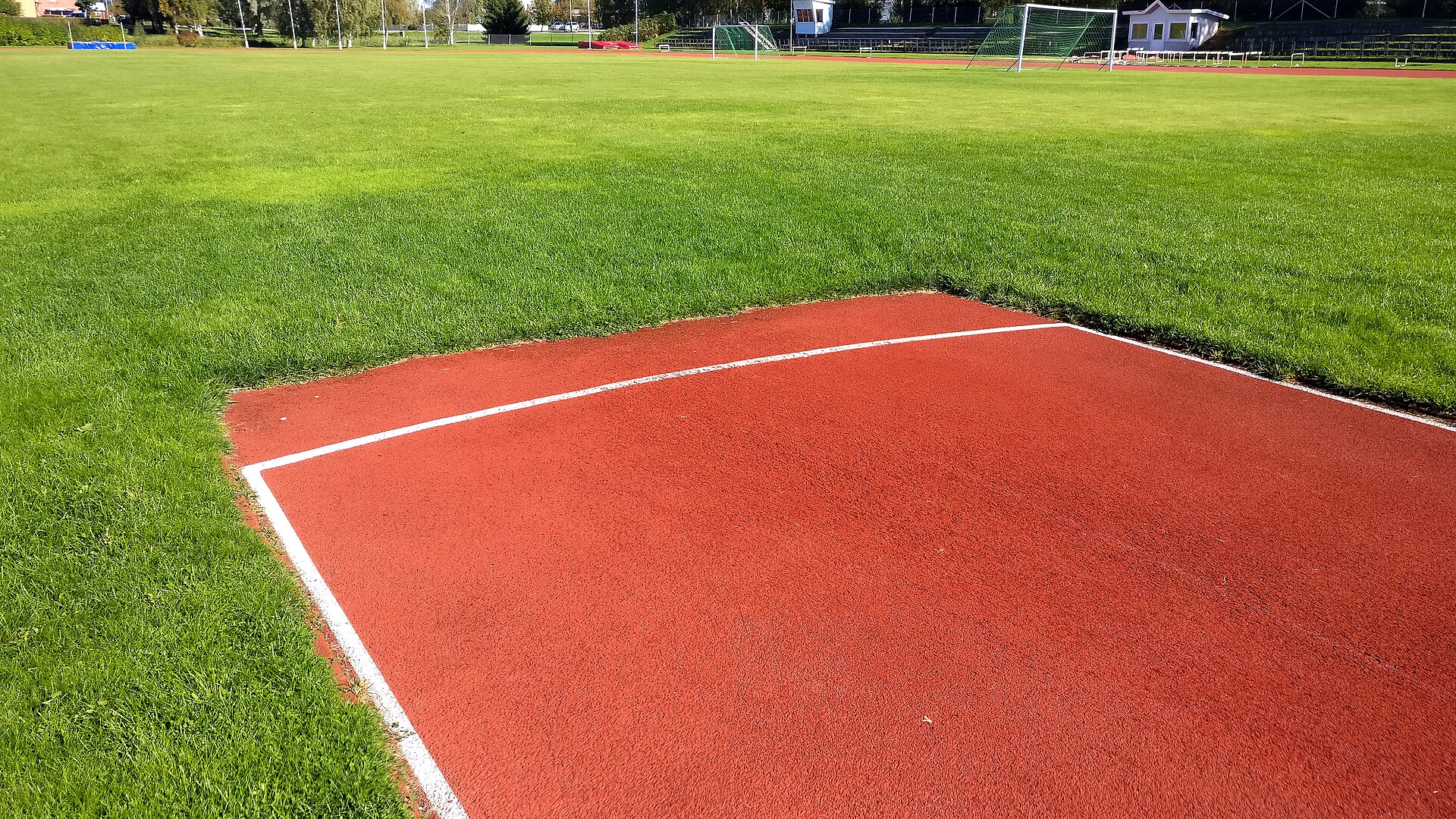
The story most people know is short. A thrower went so far that the javelin ran out of stadium, so the implement was changed. World Athletics’ own account of its history agrees on the fact and disagrees on the reason.
The record exists: 104.80 m, thrown by Uwe Hohn in June 1984. The change followed. But the governing body’s history of the implement puts the cause elsewhere: the main reason the Technical Committee decided to change the rules for javelin construction was because of the increasingly frequent flat landings and the resulting discussions and protests.
Reference The 104.80 m mark of June 1984, and the statement that the main reason for the construction change was increasingly frequent flat landings and the resulting discussions and protests, from World Athletics’ history of the implement.
That is a rule change driven by officiating, not by geography. A javelin that comes down flat produces a mark that judges have to interpret, and every interpretation is an argument. Distance was a problem; a competition that could not reliably be judged was a worse one.
What was actually changed
The centre of gravity was moved forward. World Athletics says three centimetres.
Reference That the centre of gravity was moved forward by three centimetres, from World Athletics’ history of the implement.
It is worth flagging that this figure is not agreed everywhere. Four centimetres is widely repeated in secondary accounts of the change. This article takes the governing body’s own number, and notes the disagreement rather than resolving it, because the primary document that would settle it is the 1986 specification and not any of the retellings.
Moving the centre of gravity forward, on its own, would be trivially easy to defeat. A manufacturer could put the mass where the rule demands and then restore the flight by redistributing area — building a slimmer nose and a fatter tail, or the reverse — because what governs the nose-down moment is the distance between the centre of gravity and the centre of pressure, and the centre of pressure is set by shape.
Which is why the rule that made 1986 work is not the centre-of-gravity rule. World Athletics says so directly: the regulations on the thickness of the tail ensured that other adjustments could not be made that would render the shift in the centre of gravity useless.
Reference That the regulations on the thickness of the tail ensured other adjustments could not render the centre-of-gravity shift useless, from World Athletics’ history of the implement.
The rule, drawn
The Technical Rules specify the current implement in two parts: a table of lengths, and a set of conditions on how the shaft may taper.
For the 800 g javelin the table gives an overall length of 2600–2700 mm, a distance from the tip of the metal head to the centre of gravity of 900–1060 mm, a distance from the tail to the centre of gravity of 1540–1800 mm, a metal head of 250–330 mm, a cord grip 150–160 mm wide, and a shaft diameter at its thickest point of 25–30 mm.
Reference The specification table for the 800 g javelin — overall length, tip-to-centre-of-gravity, tail-to-centre-of-gravity, metal head length, cord grip width and shaft diameter — from the Technical Rules.
Then the taper conditions, and these are the ones that matter. The point may not taper at more than 40 degrees. At 0.15 m from the tip, the diameter may not exceed 80 per cent of the shaft’s maximum diameter. At the midpoint between the centre of gravity and the tip of the metal head, it may not exceed 90 per cent. At the midpoint between the centre of gravity and the tail, it may not be less than 90 per cent. At 0.15 m from the tail, not less than 40 per cent. And the diameter at the very end of the tail may not be less than 3.5 mm.
Reference The point-angle limit of 40 degrees and the four diameter conditions — 80 per cent at 0.15 m from the tip, 90 per cent maximum at the tip-side midpoint, 90 per cent minimum at the tail-side midpoint, and 40 per cent minimum at 0.15 m from the tail — together with the 3.5 mm minimum tail diameter, from the Technical Rules.
Overall length 2.6 m–2.7 m · metal head 0.25 m–0.33 m · point angle not more than 40°
Read the four conditions in order and the design intent is unmistakable. In front of the centre of gravity, every condition is a ceiling: the shaft may be no fatter than a stated fraction. Behind it, every condition is a floor: the shaft may be no thinner than a stated fraction.
The specification does not merely place the mass. It forces surface area to sit behind where the mass is, and it forbids the obvious workaround of thinning the tail to compensate. A javelin with the centre of gravity in the front two-fifths of its length and a tail that must stay at least 90 per cent of maximum diameter at its midpoint has its centre of pressure held behind its centre of gravity by construction.
An aerodynamic force acting behind the centre of gravity produces a nose-down moment. The implement pitches down as it flies, meets the ground point-first, leaves an unambiguous mark, and travels less far as a side effect.
What is not claimed here
Two limits on this account are worth stating plainly.
The magnitude of the effect is not established by any of these documents. World Athletics’ history gives a reason and a centre-of-gravity shift; the Technical Rules give the geometry in force now. Neither is a measurement of how much distance the change cost, and the widely quoted figure of about ten per cent does not appear in either.
And the pre-1986 specification is not reproduced above. The current table shows where the rule stands, not what it was; the shape of the change is legible from the direction the conditions point, which is a weaker claim than a before-and-after comparison and the only one the documents here support.
The rest of the sequence
The 1986 change was not the first time the sport had responded to a javelin that flew better than intended, and not the last.
In the 1950s Bud Held improved the record with a hollow wooden implement whose surface area was 27 per cent greater than its predecessors’; by the 1970s metal implements had become commonplace.
Reference Bud Held’s hollow wooden javelin with 27 per cent greater surface area in the 1950s, and the arrival of metal implements as commonplace by the 1970s, from World Athletics’ history.
The women’s implement followed the men’s, slowly. A proposal was submitted in 1984 but lacked the testing data to support it; sufficient testing had been done by 1996, the changes proportional to the men’s; the proposal was accepted in 1997, records were reset in 1999, and the new specification took effect for women that year.
Reference The 1984 proposal lacking testing data, sufficient testing by 1996, acceptance in 1997, and records reset with the specification taking effect for women in 1999, from World Athletics’ history.
Thirteen years between proposal and implementation, held up by the absence of evidence. That is the same governing body that had already made the equivalent change for men, applying the same reasoning, and declining to act on it until the data existed.
There is one further clause in the current rule that reads as a summary of everything above: the javelin shall have no mobile parts or other apparatus which during the throw could change its centre of gravity or throwing characteristics.
Reference The prohibition on mobile parts or other apparatus that could change the centre of gravity or throwing characteristics during the throw, from the Technical Rules.
Having spent a rule specifying exactly where the centre of gravity must be, the rulebook adds one more forbidding anything that could move it in flight. The javelin’s whole specification is an argument about a single point along a shaft — where it sits, what sits behind it, and whether anyone can be allowed to change it once the implement has left the hand.
Read the evergreen pages
This piece is an argument. These are the reference pages on SocialSportHub that document the same subjects.
References
- [1]World AthleticsGoverning body. From Held to Hohn and beyond — the evolution of the javelin, by Hannah Martin, 8 October 2022. Accessed 6 September 2026.
- [2]World AthleticsGoverning body. Book C — C2.1 Technical Rules: javelin specifications and construction (World Athletics Book of Rules). Accessed 6 September 2026.
Continue reading
Editor’s pick
The shoe rule never mentions a spring
World Athletics' shoe regulations are read as a limit on how much energy a sole may return. Read the document and the limits are on something else entirely: a thickness at two specified points, the topology of a rigid structure, and whether anyone can buy the shoe.
Editor’s pick
The wind limit rounds against the sprinter, and the rule says how
A record stands or falls on a wind reading averaged over ten seconds at one point beside lane one. The rule that converts that reading into a number is not symmetrical, and the asymmetry always runs the same way.
More on running
Athletics wrote its recent history into the definition of a shoe
The Athletic Shoe Regulations define an approved shoe in four clauses, and each clause names a different date. Read as a chronology rather than a definition, it is the record of a governing body absorbing a technology it did not anticipate.