
The corner three is a shorter shot, and FIBA's own rulebook says so
Basketball's three-point line is defined twice over: as an arc 6.75 m from the basket, and as a pair of straight lines 0.90 m inside the sidelines. On a 15-metre court those two definitions cannot both give the same distance, and the gap they leave is fifteen centimetres wide.
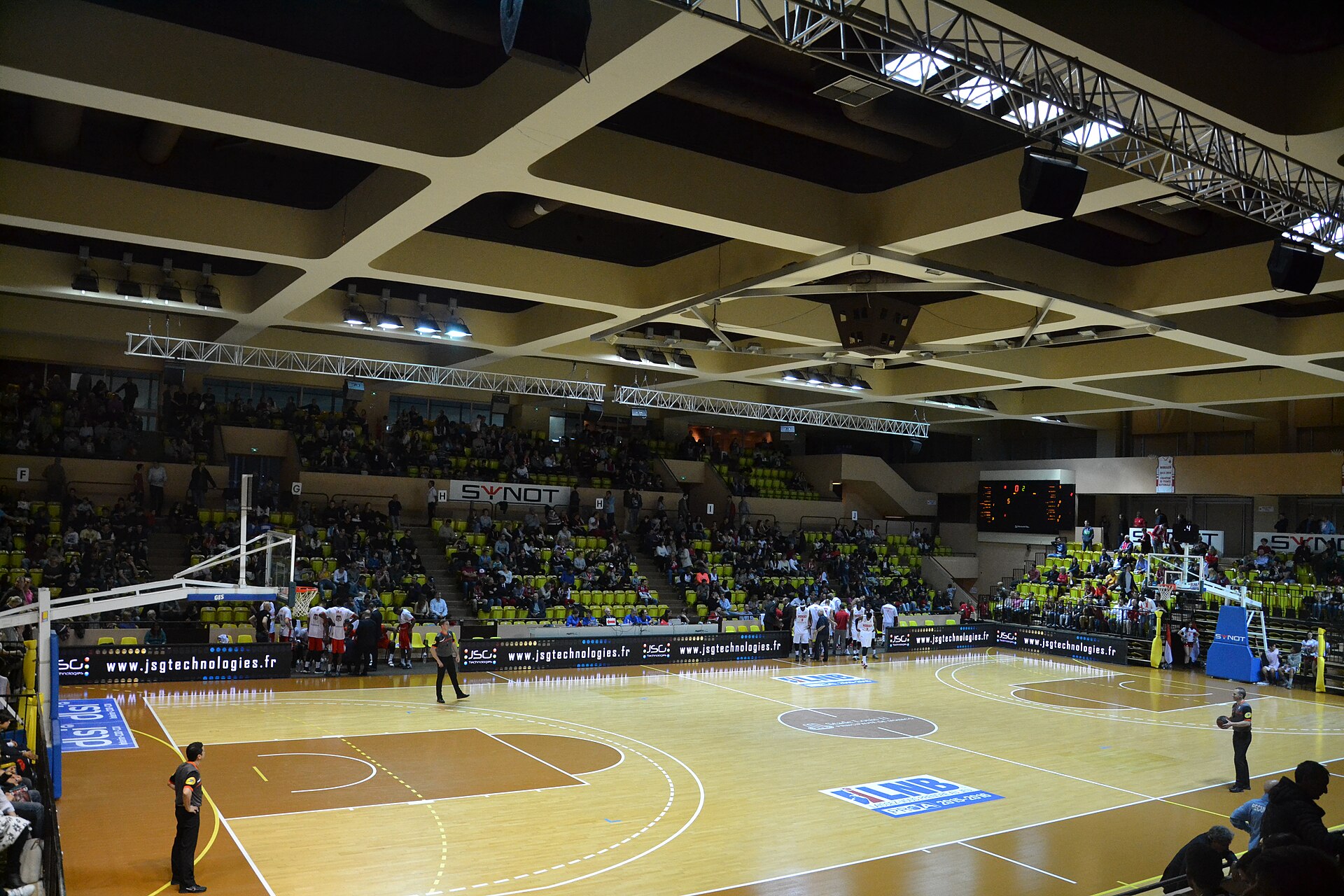
FIBA’s rules describe the three-point line in two sentences, and the two sentences do not measure the same thing.
The first gives an arc: a radius of 6.75 m, taken from the point on the court beneath the exact centre of the opponents’ basket to the outer edge of the arc. The second gives two straight lines, extending from and perpendicular to the endline, with their outer edge 0.90 m from the inner edge of the sidelines. The arc, the rule adds, is joined to the parallel lines.
Reference The two-part definition of the three-point goal area, including the 6.75 m radius, the 0.90 m inset and the note that the arc is joined to the parallel lines, from Article 2.5.4.
One is a distance from the basket. The other is a distance from the edge of the floor. They agree only if the floor happens to be the right width, and basketball’s floor is not.
The arithmetic the rule does not do
A court is 28 m long and 15 m wide, measured from the inner edge of the boundary line. The basket sits on the long axis, so the point beneath it is 7.50 m from either sideline. The straight sections of the three-point line sit 0.90 m inside those sidelines. Subtract.
Reference Court dimensions of 28 m by 15 m, measured from the inner edge of the boundary line, from Article 2.1.
The straight sections are 6.60 m from the point beneath the basket. The arc is 6.75 m from it. The same line, worth the same three points, is fifteen centimetres nearer the basket down the sides than it is at the top.
For the two definitions to have agreed, the court would have needed to be 15.30 m wide — 7.65 m either side of the basket, less the 0.90 m inset, giving exactly 6.75 m. FIBA fixed the court at 15 m and the arc at 6.75 m, and the 0.90 m inset is what fell out. The corner three is not a design decision anyone made. It is the remainder.
- 6.60 m — the straight sections, level with the ring. The shortest three-pointer on the court.
- 6.75 m — the arc, everywhere along its length.
- Where the arc meets the straight, 1.42 m past the level of the ring, because 6.60² + 1.42² = 6.75².
- The deep corner on the baseline: 6.79 m, farther from the basket than the top of the arc.
Where the line stops being a curve
The join is solvable. The arc has radius 6.75 m; the straight sits 6.60 m from the centre; the point where a circle of one radius crosses a line at the other distance is a right-angled triangle away.
√(6.75² − 6.60²) = 1.42 m.
So the arc meets the straight 1.42 m beyond the level of the ring, which is 2.99 m from the endline. Everything nearer the baseline than that is on the straight section, at less than the nominal distance. Everything past it is on the arc, at exactly 6.75 m. The corner three is not a vague region. It is a segment three metres long, and its length can be derived from two numbers in the rulebook.
The part that surprises people
Distance along that straight section is not constant. It is shortest where the shooter stands level with the ring — 6.60 m — and grows in both directions from there.
Walk to the baseline itself and the shot lengthens again. The corner spot on the endline is 6.60 m sideways from the basket point and 1.575 m behind it, because the rule puts the basket’s floor point 1.575 m from the inner edge of the midpoint of the endline. The straight-line distance is √(6.60² + 1.575²) = 6.79 m.
Reference The 1.575 m distance from the inner edge of the midpoint of the endline to the point beneath the centre of the basket, from Article 2.5.4.
The deep corner, right on the paint of the baseline, is therefore a longer shot than one from the top of the arc. The bargain corner is not the corner. It is the spot a metre and a half up the line, level with the ring, where the geometry bottoms out.
Two-point shots that are longer than three-point shots
Follow the consequence. A shot released just inside the arc at the top of the key travels 6.74 m across the floor and scores two. A shot released from the corner line, level with the ring, travels 6.60 m and scores three. The rule creates a band in which a shorter shot is worth more.
The band is exactly as wide as the disagreement between the two definitions: fifteen centimetres. It is not large, and no coach draws a play around it. But it is the reason the corner is worth standing in, and it is written into the rule rather than into anyone’s tactics.
The line itself belongs to the two-point side. FIBA states plainly that the three-point line is not part of the three-point goal area, so a foot touching it is a two-point attempt.
Reference That the three-point line is not part of the three-point goal area, from Article 2.5.4.
What the rulebook means by “distance”
There is a second thing the arithmetic exposes, and it is easy to miss because it is stated so plainly. Both figures are measured on the floor: 6.75 m from the point on the court beneath the centre of the basket; 0.90 m from the inner edge of the sideline. Neither is the distance the ball travels, and neither is the straight line from the shooter’s hand to the ring.
Basketball’s rulebook measures shot distance in plan view. It is a map, not a trajectory. Every claim about how far a three-pointer is — including every claim in this article — is a claim about where a pair of feet were, not about how far anything was thrown.
That is a reasonable way to write a rule. A referee can look down at the floor; they cannot measure a parabola. But it means the sport’s own definition of a long shot is indifferent to the two things that actually make it hard, which are the height of the ring above the floor and the arc the ball has to take to clear it. The line rewards a position. The difficulty lives somewhere else.
Why the shape matters more than the fifteen centimetres
The distance saved in the corner is small. The space saved is not.
Because the straight sections run parallel to the sidelines, the three-point area in the corner is a strip 0.90 m wide, bounded on one side by the line and on the other by out of bounds. A shooter standing there has under a metre of floor. Everywhere else on the arc, the three-point area opens backwards indefinitely.
That produces the asymmetry that shapes how the space is defended. Along the arc, a defender can be beaten backwards — the shooter can step away from the line and remain a threat, and the defender must respect ground behind. In the corner there is no ground behind. A defender who closes out to the line has nothing left to cover, because the rule has already put the boundary there.
Both effects push the same way. The corner is the shortest three and the one a defender can most completely take away, which is why the value of standing in it depends so heavily on whether anyone is standing near you. Neither of those properties is a discovery about basketball. They are consequences of a court that is 15 m wide and an arc that is 6.75 m, and of a rule that had to reconcile them with a straight line.
Reference A team must attempt a shot within 24 seconds of gaining control of a live ball on the court, under Article 29.1.1 — the constraint that makes where a shooter is standing when the ball arrives a question of arithmetic rather than preference.
The line was drawn to be one distance. The floor made it two. Everything else follows from that, and none of it is in the rulebook.
Read the evergreen pages
This piece is an argument. These are the reference pages on SocialSportHub that document the same subjects.
References
- [1]FIBAGoverning body. Official Basketball Rules 2026 — Articles 2.1, 2.5.3, 2.5.4, 2.5.7. Accessed 6 September 2026.
- [2]FIBAGoverning body. Official Basketball Rules 2026 — Article 29, Shot clock. Accessed 6 September 2026.
Continue reading
Editor’s pick
Fourteen seconds is not a shorter twenty-four
Basketball's shot clock has two numbers, and the smaller one is not a discount on the larger. Read against FIBA's Article 29, the fourteen-second reset turns out to be a rule about who lost the ball, not about how much time is left.
Editor’s pick
The line under the basket that nobody paints
Basketball's no-charge semi-circle is the one area of the court where the same collision changes owner. Part of its boundary is painted on the floor. The rest of it exists only in the rulebook, projected down from the front edge of a backboard three metres in the air.
More on basketball
Five sports paint a line around the court. Only four of them agree it is part of it
A ball on the line is in, unless you are playing basketball, where the boundary line is not court at all. The disagreement is written into the rulebooks, and it decides which edge of the paint the tape measure is held against.