
Basketball's most important boundary is not painted, and it is a different size for everyone
FIBA's cylinder principle gives each player a personal volume of court whose dimensions vary with their height and size. It is the one rule in the book measured in units of the body rather than in metres — and there are two versions of it, depending on who has the ball.
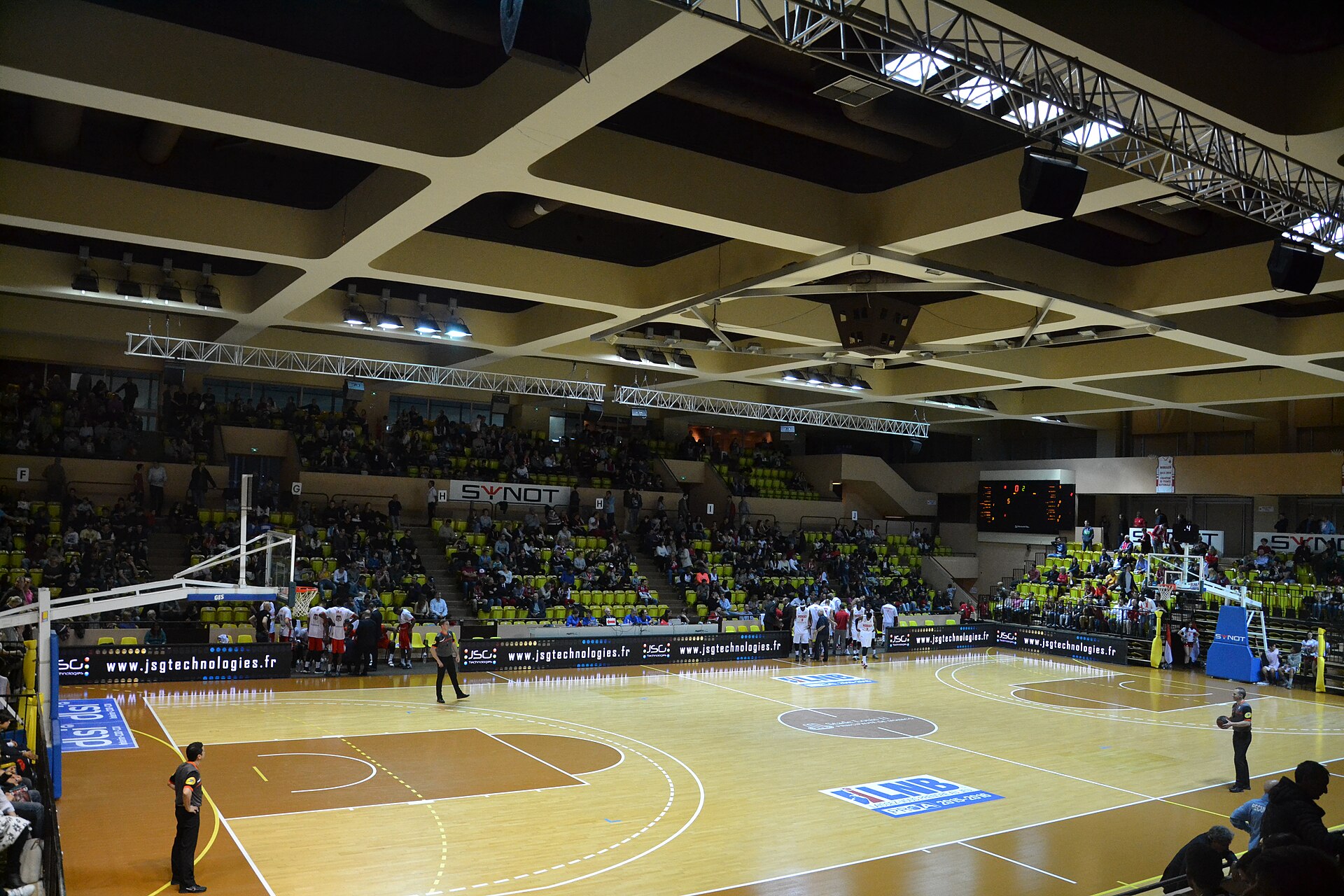
Every distance in basketball’s rulebook is given in metres. The court is 28 by 15. The arc is 6.75 from a point on the floor. The free-throw line is 5.80 from the endline. Then Article 33 opens, and the unit changes.
The cylinder principle is defined as the space within an imaginary cylinder occupied by a player on the court. The dimensions, and the distance between the player’s feet, shall vary according to the height and size of the player.
Reference The definition of the cylinder principle as the space within an imaginary cylinder occupied by a player, whose dimensions and foot spacing vary with the player’s height and size, from Article 33.1.
Every other measurement in the book applies identically to everyone on the floor. This one is issued per player, and its size is a property of the person.
What the boundary is made of
The cylinder is not an abstract column. Its walls are anatomical, and the rule names them.
For a defensive player, or an offensive player without the ball, the cylinder is limited at the front by the palms of the hands, at the rear by the buttocks, and at the sides by the outer edge of the arms and legs. It includes the space above the player. The hands and arms may be extended in front of the torso no further than the position of the feet and knees, with the arms bent at the elbows so that the forearms and hands are raised in the legal guarding position.
Reference The boundaries of the cylinder for a defensive player or an offensive player without the ball — palms at the front, buttocks at the rear, outer edge of arms and legs at the sides — that it includes the space above the player, and the limit on extending the hands and arms, from Article 33.1.
Read that as a construction rather than a description and something becomes clear: the cylinder is defined by where a player’s body can legally be, not by where it happens to be. Palms forward, arms bent, elbows in, hands no further forward than the feet and knees. That is a posture, and the rule uses it as a boundary. A defender who adopts it owns the volume it describes; a defender who reaches beyond it has left their own cylinder rather than entered someone else’s.
The second cylinder
The unusual part is that the ball changes the shape of the space you are entitled to.
For the offensive player with the ball, the boundaries are different: at the front by the feet, bent knees and arms holding the ball above the hips; at the rear by the buttocks; at the sides by the outer edge of the elbows and legs. And the rule states the entitlement directly — the offensive player with the ball must be allowed enough space for a normal basketball play within the cylinder, where normal basketball play includes starting a dribble, pivoting, shooting and passing.
Reference The separate boundaries of the cylinder for the offensive player with the ball, and the requirement that they be allowed enough space for a normal basketball play, defined to include starting a dribble, pivoting, shooting and passing, from Article 33.1.
The front wall has moved. For a player without the ball it is the palms; for a player holding it, the feet, bent knees and the arms carrying the ball. That is a larger and lower volume, and it is larger in exactly the direction a player needs in order to do the four things the rule lists.
The rule then closes the obvious exploit. The offensive player cannot spread the legs or arms outside the cylinder and cause illegal contact with a defender in order to gain additional space.
Reference That the offensive player may not spread the legs or arms outside the cylinder to cause illegal contact and gain additional space, from Article 33.1.
And it closes the mirror exploit on the other side: a defender may not enter the cylinder of the offensive player with the ball and cause illegal contact while that player is attempting a normal basketball play within it.
Reference That the defensive player may not enter the cylinder of the offensive player with the ball and cause illegal contact during a normal basketball play, from Article 33.1.
Verticality: the space above
The second half of Article 33 extends the cylinder upwards and settles who is responsible when two of them collide.
Each player has the right to occupy any position, that is, any cylinder, not already occupied by an opponent. The principle protects the space the player occupies and the space above it when jumping vertically within that space. When a player leaves the vertical position and contact occurs with an opponent who had already established their own vertical position, the player who left the vertical position is responsible for the contact. And a defensive player must not be penalised for leaving the court vertically within their cylinder, or for having hands and arms extended above and within it.
Reference The right to occupy any unoccupied position, the protection of the space above when jumping vertically, the allocation of responsibility to the player who left the vertical position, and the protection of a defender who leaves the floor vertically within their own cylinder, from Article 33.2.
That is an unusually clean rule for something as chaotic as contested airspace. It does not ask who jumped first, or who was more committed, or whose intention was better. It asks one question with a geometric answer: did either player leave their own column? If one did and contact followed, that player is responsible.
The corollary is the part players use most. A defender who goes straight up, hands overhead, has done nothing wrong even if the shooter runs into them — because everything the defender did happened inside a volume the rule says they own. The familiar instruction to stay vertical is not coaching shorthand. It is the literal test the rulebook applies.
Why the unit had to change
It is worth asking why this one rule abandons metres, because the answer explains what the rule is for.
Everything else the rulebook measures is a relationship between a player and the court: how far from the basket, how long in the restricted area, which side of a line. The court is the same for everybody, so a number in metres works.
The cylinder measures a relationship between a player and another player. Two bodies of different sizes, moving, in contact. A fixed distance would be meaningless here: half a metre of clearance is generous for one pair of players and impossible for another, and a rule stated that way would penalise size rather than conduct.
So FIBA specifies a shape instead of a distance and lets the shape scale with whoever is inside it. The cost is that the boundary cannot be drawn, cannot be checked against a diagram, and has to be judged in real time by an official watching two people collide. The benefit is that it applies the same standard to a guard and a centre without giving either an advantage the other cannot have.
The court’s other lines tell a player where they may stand. This one tells them how much of themselves they may put somewhere — and it is the only rule in basketball whose answer is different for every person on the floor.
Read the evergreen pages
This piece is an argument. These are the reference pages on SocialSportHub that document the same subjects.
References
- [1]FIBAGoverning body. Official Basketball Rules 2026 — Article 33.1, cylinder principle, and Article 33.2, principle of verticality. Accessed 6 September 2026.
Continue reading
Editor’s pick
The line under the basket that nobody paints
Basketball's no-charge semi-circle is the one area of the court where the same collision changes owner. Part of its boundary is painted on the floor. The rest of it exists only in the rulebook, projected down from the front edge of a backboard three metres in the air.
Editor’s pick
The corner three is a shorter shot, and FIBA's own rulebook says so
Basketball's three-point line is defined twice over: as an arc 6.75 m from the basket, and as a pair of straight lines 0.90 m inside the sidelines. On a 15-metre court those two definitions cannot both give the same distance, and the gap they leave is fifteen centimetres wide.
More on basketball
Five sports paint a line around the court. Only four of them agree it is part of it
A ball on the line is in, unless you are playing basketball, where the boundary line is not court at all. The disagreement is written into the rulebooks, and it decides which edge of the paint the tape measure is held against.