
The kinetic chain behind a serve
Between the pelvis and the upper arm, measured rotation speed climbs more than fivefold. That escalation, not the arm at the end of it, is where a fast serve comes from.
A serve is usually described as an arm action. The measurements describe something narrower. When eight professional players were fitted with inertial sensors on the pelvis, trunk and dominant upper arm, and 347 of their serves analysed, the peak rotation speeds of those three segments climbed in a staircase: roughly 590 degrees per second at the pelvis, roughly 900 at the trunk, roughly 3,200 at the upper arm. The first serves left the racket at an average of about 175 km/h.
Reference Mean peak segment angular velocities and mean first-serve ball speed, measured with a custom inertial measurement unit system across 347 analysed serves by eight professional players.
Nothing in the anatomy of a shoulder accounts for a more than fivefold jump between the pelvis and the humerus. The arm is where the speed arrives, not where most of it is made, and what arranges the delivery is everything underneath it — which is most of what the tennis serve actually is.
Biomechanists call the arrangement a kinetic chain: a stroke treated as a sequence of motions that begins with the lower limbs and continues through rotations of the trunk and the upper limb, so that mechanical energy can be generated, summed and transferred on its way to the racket.
Reference Definition of the serve as a kinetic chain beginning with lower-limb actions and allowing the generation, summation and transfer of mechanical energy.
The ground is the first link
A player behind the baseline has nothing external to push against except the court. Extending the hips and knees drives the feet into the surface, which returns an equal and opposite force up through the skeleton. Muscles supply the energy; the ground supplies the only external force large enough to lift a whole body and set it turning. The coaching review published by the sport’s international governing body puts it bluntly: the legs are the launching pad of the service motion, and the preparation phase exists to turn ground reaction force into the power the rest of the motion needs.
Reference The serve described as a kinetic chain whose starting point is the legs, and the preparation phase framed as the use of ground reaction forces to generate power.
How much that opening push matters is harder to pin down, because the direct evidence is thin. The study that couples whole-body kinematics with force platforms across every phase of the serve calls itself preliminary: four nationally ranked players, five flat serves each, a ten-camera optoelectronic system, one foot on each of two platforms. It reports eleven parameters correlated with the racket velocity eventually reached — nine very large correlations and two almost perfect ones, both of those negative — grouped by phase, not ranked against each other. The earliest in the order of the motion is the vertical ground reaction force under the back foot during the release-backward phase, while the player is still moving backwards. The rest fall in the phases after it: trunk axial rotation while loading; knee flexion and hip and shoulder rotation while cocking; then centre-of-gravity velocity with trunk, elbow and shoulder actions during acceleration. With four players, that indicates where to look, not what matters most.
Reference Whole-body kinematics coupled with two force platforms in four first-series French-ranked players, five flat serves each; eleven parameters identified as very largely or almost perfectly correlated with racket velocity across the phases of the serve, on the paper’s own preliminary framing.
Proximal to distal
The ordering principle is the summation of speed. Each segment begins accelerating as the one before it approaches maximum and starts to give way, so the last link inherits the speed already built and adds its own. In practice that is a control problem: the accelerations and decelerations it asks for are separated by tens of milliseconds.
The sharpest picture comes from a neighbouring motion. A meta-analysis pooling fourteen studies of overhead throwing in team handball — a movement its authors list alongside the tennis service and the volleyball spike as instances of the same phenomenon — found the initiation of joint angular velocities following a strict order outward from the middle of the body.
- Pelvis rotation begins first.
- Trunk rotation follows, then trunk flexion.
- Shoulder internal rotation starts next.
- Elbow extension starts last.
For the timing of the maxima the order held as far as the trunk, then folded over at the arm: peak elbow extension came first, on average nine to thirteen milliseconds before the ball left the hand depending on the throw, and peak shoulder internal rotation arrived after release. The chain is a queue with a known shape, and congestion at the end of it.
Reference Meta-analysis of fourteen team-handball throwing studies; sequence for the initiation of joint angular velocities and for the timing of the maxima relative to ball release.
The failure mode has a shape too. Where an athlete moves the joints and segments nearly simultaneously — blocked rotation, in the meta-analysis vocabulary — the plot of segment timings flattens toward a horizontal line where a sequenced action ascends. Nothing has been lost to weakness. It has been lost to simultaneity.
Reference Blocked rotation described as moving all joints and segments nearly simultaneously, yielding a nearly horizontal timing plot rather than an ascending one.
What the arm actually adds
Once the chain reaches the shoulder, the arm’s share has been tabulated directly. A review of tennis biomechanics puts the approximate contributions to racket velocity at impact in a power serve at 40 per cent from internal rotation of the upper arm, 30 per cent from flexion of the hand at the wrist, 15 per cent from horizontal flexion of the upper arm, 10 per cent from the shoulder and 5 per cent from forearm pronation.
Reference Approximate contributions to racket velocity at impact for the power serve, tabulated in a review of tennis biomechanics.
Two things in that table are easy to misread. The figures apply at the instant of impact and, as the review says explicitly, take no account of leg drive — they describe how the speed is applied, not where it came from. And the small percentages are not idle: pronation is chiefly responsible for the orientation of the racket face, and elbow extension mainly buys height at contact. The largest single entry is a rotation about the long axis of the humerus, a motion that barely alters the outline of the arm and is correspondingly hard to see.
Reference The review notes that the tabulated contributions apply at impact only and exclude leg drive, and that pronation governs racket orientation while elbow extension assists impact height.
Why timing outranks the parts
Timing is not decoration on the sequence; it changes how much force the tissue can make at all. Muscle and tendon stretched and then immediately shortened return part of the stored elastic energy, and that return decays fast. The same review reports internal rotation of the upper arm running about 20 per cent faster with no pause between the stretch and the shortening than with a pause of one and a half seconds, and cites bench-press work in which roughly 55 per cent of the stored energy had gone after about a second.
Reference Stretch-shorten cycle effects reported in the review, including the no-pause versus 1.5-second-pause comparison for upper-arm internal rotation speed and the bench-press energy-loss figure.
The intervals involved sit below the resolution of the eye. In the handball data, peak trunk rotation velocity preceded peak trunk flexion by about 30 milliseconds on average, and the authors say plainly that a coach cannot see which came first. In the professional tennis measurements the mean gap between the trunk peak and the upper-arm peak was about 125 milliseconds: the arm phase, compressed into an eighth of a second.
Reference Mean intersegmental interval between peak trunk and peak upper-arm angular velocity on first serves.
That same tennis study complicates the tidy version, and the complication is worth stating rather than smoothing over. The interval between the pelvis peak and the trunk peak was negative: the trunk peaked roughly 28 milliseconds before the pelvis, so these players were not running a strict proximal-to-distal order at the maxima. None of the intersegmental intervals were associated with ball speed either. What was associated with it was magnitude — how fast the trunk and the upper arm turned.
Reference Negative pelvis-to-trunk intersegmental timing, the absence of an association between intersegmental timing and ball speed, and the positive associations between ball speed and trunk and upper-arm peak angular velocities.
That narrows the claim rather than refuting it. Timing is not a dial with one correct setting; it is the condition under which large segment velocities become available at all. What lets the trunk and arm turn that fast is that the segments beneath have already loaded them and are giving way when they are asked to.
Where the power leaks
A study that tracked mechanical energy rather than angles puts this in the right currency. Nineteen high-level male players were captured optoelectronically, the forces and torques at the joints of the serving arm computed by inverse dynamics, and the quality of energy flow defined as a ratio: the mean rate at which energy left the trunk during late cocking against the mean rate at which it entered the hand-and-racket segment during acceleration. The players with the highest quality of flow had the highest ball velocities and, at the same time, the lowest measured loads at the arm’s joints.
Reference Joint power analysis of the serving arm in 19 high-level male players; the definition of the energy-flow quality indicator and its relationships with ball velocity and upper-limb joint kinetics.
The converse is why a serve resists being solved by strength. Where flow through the chain is poor, the paper describes a catch-up situation: the player has to create larger loads at the most distal joints to offset the energy dissipated along the way. The arm is not producing extra speed there. It is compensating for speed that failed to arrive.
Reference The catch-up situation, in which poor energy flow obliges players to create more load at the most distal joints to offset dissipation along the kinetic chain.
The tennis review makes the structural version of the same point: remove one segment from the chain and reliance on the others increases to accommodate the loss. A skipped link does not subtract its own contribution so much as move it outward, onto smaller segments with less time to supply it.
Reference Removing one segment from the chain increases reliance on the remaining segments to accommodate the loss.
A class of solutions
Treating the serve as coordination rather than strength has one further consequence: there is no single correct pattern to copy. The handball meta-analysis is explicit that only the topology of the sequence — its shape and timing — is the thing to reproduce, and that individual optimisation happens inside that envelope. The tennis review reports the same from the other direction, in the forehand drive: wrist and elbow angular positions are consistent at impact without consistent patterns of angular velocity and acceleration at those joints.
Reference Coordination variability, and the argument that only the topology of the proximal-to-distal sequence should be treated as the target, with individual optimisation inside it.
The architecture is not specific to tennis. The overhead throw in handball and the volleyball spike are described in the same terms: different implements bolted to the end of the same machine, handing the momentum of a large body to a small one. Serving in tennis is one instance of it.
Which leaves the ordinary description backwards. The fastest-moving part of the body at contact is the last to be recruited, and its tabulated contributions are measured for an instant that excludes the leg drive that made them possible. The arm is not the engine. It is the end of a chain whose speed was settled several segments upstream, in intervals too short to watch — which is why a serve is closer to a problem in coordination than a problem in strength.
Read the evergreen pages
This piece is an argument. These are the reference pages on SocialSportHub that document the same subjects.
References
- [1]Frontiers in Sports and Active Living (via PubMed Central, US National Library of Medicine)Peer-reviewed. Uncovering the hidden mechanics of upper body rotations in tennis serves using wearable sensors on Dutch professional players. Accessed 2 September 2026.
- [2]The American Journal of Sports Medicine (author copy hosted by Inria, Rennes)Peer-reviewed. Energy Flow Analysis During the Tennis Serve: Comparison Between Injured and Noninjured Tennis Players. Accessed 2 September 2026.
- [3]World Tennis Coaching & Sport Science Review (formerly ITF Coaching & Sport Science Review)Governing body. Should players serve using the foot-up or foot-back technique?. Accessed 2 September 2026.
- [4]Frontiers in Sports and Active Living (via PubMed Central, US National Library of Medicine)Peer-reviewed. Are there kinematic and kinetic parameters correlated with racket velocity during the tennis serve? A preliminary comparison between a slow and a fast serve for performance improvement. Accessed 2 September 2026.
- [5]Journal of Human Kinetics (via PubMed Central, US National Library of Medicine)Peer-reviewed. Systematic Review and Meta-Analysis on Proximal-to-Distal Sequencing in Team Handball: Prospects for Talent Detection?. Accessed 2 September 2026.
- [6]British Journal of Sports Medicine (via PubMed Central, US National Library of Medicine)Peer-reviewed. Biomechanics and tennis. Accessed 2 September 2026.
Continue reading
More on tennis
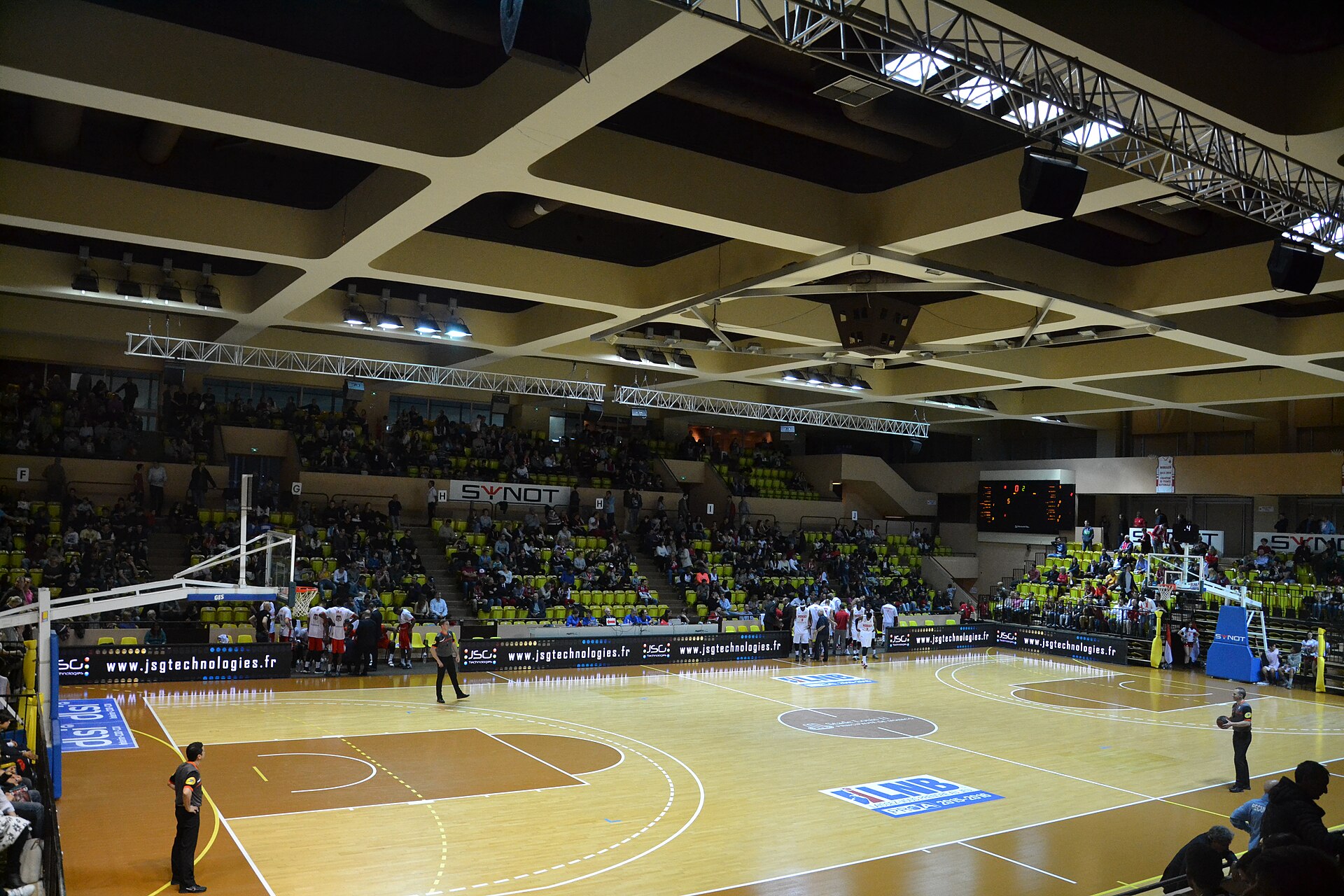
Five sports paint a line around the court. Only four of them agree it is part of it
A ball on the line is in, unless you are playing basketball, where the boundary line is not court at all. The disagreement is written into the rulebooks, and it decides which edge of the paint the tape measure is held against.
More on tennis
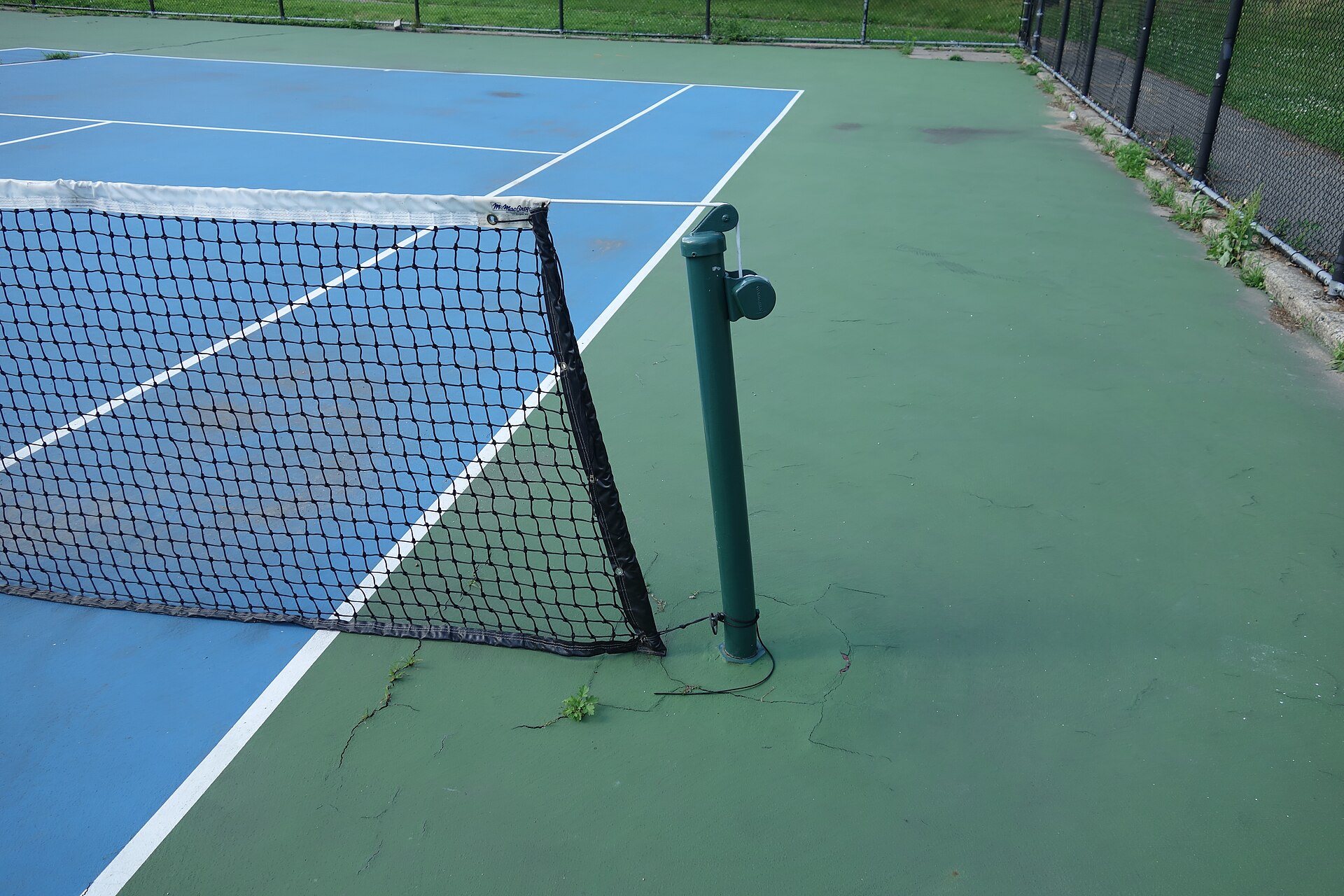
Three sports hang a cord between two posts, and all three answer the sag differently
A strung net always dips in the middle. Tennis decided to make the dip 156 millimetres and mandated a strap to produce it; badminton lets it be 26; volleyball forbids it and allows 20 millimetres of error. One physical fact, three regulatory answers.
More on tennis
Tennis spent two years working out what its own courts were doing
Until 2000 the sport had no official way to say how fast a surface played. What it built afterwards was replaced within eight years, because the first measure did not match what players said they felt — and the replacement is still only valid for the day the test was run.