
A sprint is not timed to the runner. It is timed to the torso
World Athletics defines the finish as the instant a specific part of a specific body reaches a vertical plane. Producing that instant takes a camera aligned with the line, a thousand frames a second, and a test run before every session to prove the clock started when the gun did.
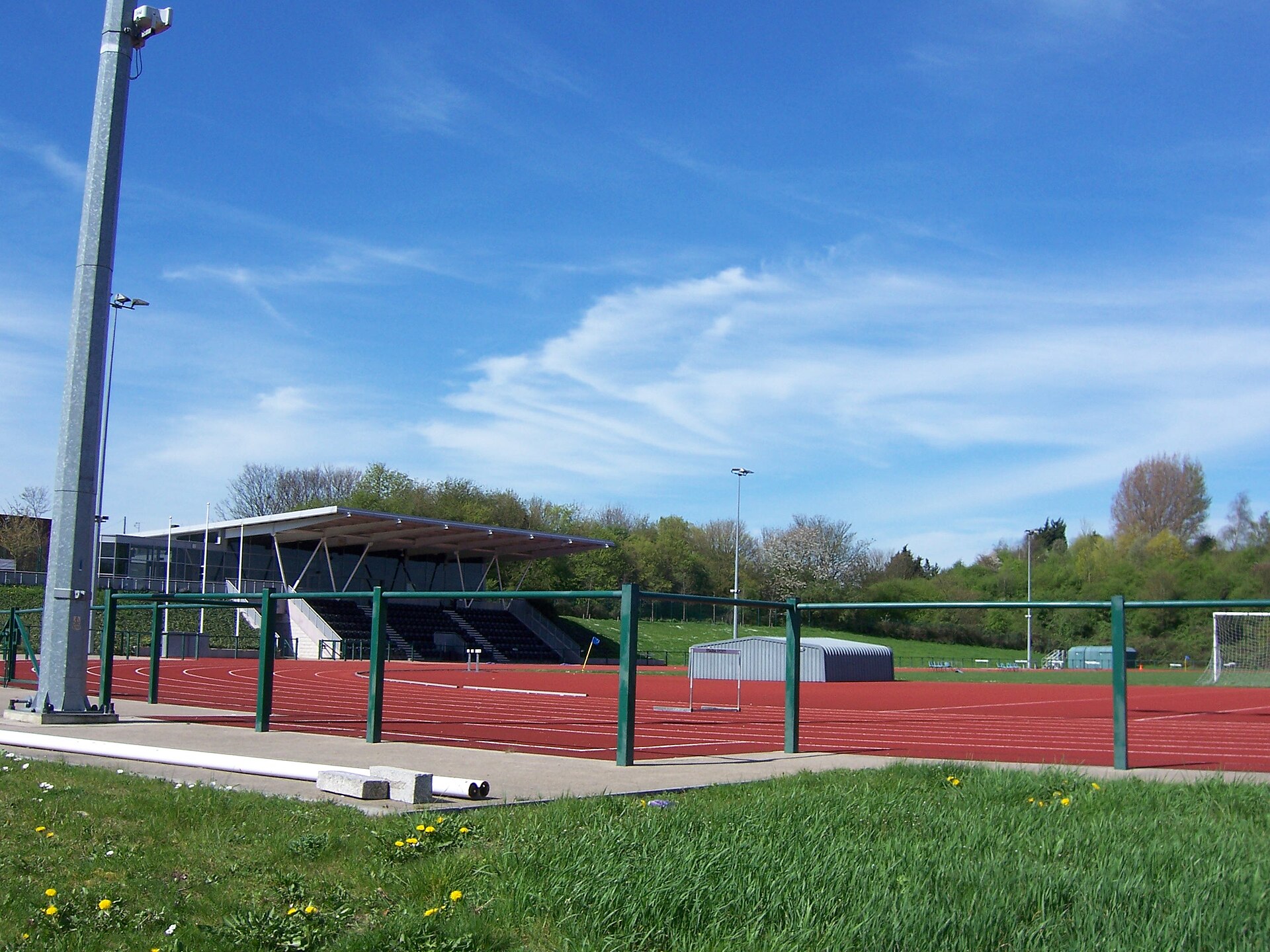
The finish of a race is denoted by a white line 50 mm wide. That line is not where the race ends.
Athletes are placed in the order in which any part of their bodies — torso, as distinguished from the head, neck, arms, legs, hands or feet — reaches the vertical plane of the nearer edge of the finish line. And the time is taken to the same moment.
Reference The 50 mm white finish line, and the definition of the finish as the torso — expressly not head, neck, arms, legs, hands or feet — reaching the vertical plane of the nearer edge, from the Technical Rules.
Two substitutions have happened in that sentence, and both matter.
The line has become a plane: not the painted stripe but the vertical surface standing above its nearer edge. The remaining 50 mm of paint is on the far side of the finish, already run.
And the runner has become the torso. An outstretched hand crossing first has not finished. A head thrown forward has not finished. A leading foot has not finished. The rule lists six body parts and excludes all of them, leaving one.
Why the torso
The choice looks arbitrary until you consider the alternatives.
Timing to whichever part arrives first would reward a lunge with the hand or head — actions that move a small mass forward without moving the athlete, and that can be performed at almost any speed. The person who ran faster would not necessarily win.
Timing to the whole body would need a definition of when a body has arrived, which is worse: a runner is spread across half a metre of track at any instant.
The torso is the compromise. It is the largest single mass and the closest thing to the centre of the athlete, so it is the part that cannot be thrown forward independently. Leaning at the line still works, because leaning brings the torso forward. Reaching does not.
It is also, not incidentally, the part a camera can identify. Every element of the rule that follows is about producing an image in which somebody can see exactly when a torso crossed a plane.
Three ways to produce a time
Three methods of timekeeping are recognised as official: hand timing; fully automatic timing obtained from a photo-finish system; and transponder timing, permitted only for competitions under the rules covering races not held completely in the stadium and related events.
Reference The three recognised official timekeeping methods and the restriction of transponder timing to races not held completely in the stadium and related competitions, from the Competition Rules.
The restriction on transponders is the tell. A transponder records when a chip passed a detection point — a proxy for the athlete, and not the torso. On a marathon course, where the finish may be decided by minutes and no photo-finish camera can cover the whole field, that proxy is entirely adequate. In a stadium, where sprint finishes are separated by hundredths, it is not, and the rules do not allow it.
What a photo-finish system has to prove
The requirements on a fully automatic system are unusually explicit, and they read as a list of the ways such a system can lie.
It must have been tested and hold a certificate of accuracy issued within four years of the competition. It must capture the finish through a camera positioned in the extension of the finish line, producing a composite image. For the top competition categories that image must be captured at a minimum of 1,000 frames per second, and for other competitions at a minimum of 100. In each case the image must be synchronised with a uniformly marked time-scale graduated in 0.01 seconds.
Reference The four-year certificate of accuracy, the camera positioned in the extension of the finish line, the composite image, the minimum frame rates of 1,000 and 100 frames per second by competition category, and the time-scale graduated in 0.01 seconds, from the Technical Rules.
Notice the mismatch between the last two figures. The camera samples at 1,000 frames per second — a millisecond of resolution — while the published time-scale is graduated in hundredths. The system is built ten times finer than the unit it reports, which is what makes the reported unit trustworthy rather than marginal.
The camera’s position is the other load-bearing requirement. In the extension of the finish line means the camera looks straight down the plane, so that the image it builds is a picture of the plane itself over time rather than a picture of the track. That is why a photo-finish image looks strange: the horizontal axis is not distance, it is time.
To make that image readable, the rule paints the track. The intersection of the lane lines and the finish line must be coloured black in a suitable design, confined solely to the intersection, extending no more than 20 mm beyond and not extended before the nearer edge of the line.
Reference The black colouring at the intersection of the lane lines and the finish line, confined to the intersection, no more than 20 mm beyond and never extended before the nearer edge, from the Technical Rules.
“Not extended before the nearer edge” is the important half. A black mark placed even a centimetre early would put a false reference in front of the plane the camera is watching, and the image would read a fraction too soon for everyone in that lane.
The test before every session
The start is the other place a timing system can be wrong, and the rules attack it directly.
The system must be started automatically by the Starter’s signal, so that the overall delay between the report from the muzzle, or its equivalent visual indication, and the start of the timing system is constant and equal to or less than 0.001 second.
Reference The requirement that the system start automatically from the Starter’s signal with a constant delay equal to or less than 0.001 second, from the Technical Rules.
And this is not assumed. Before the beginning of each session, the Chief Photo Finish Judge, working with the Start Referee and the Starter, initiates a zero control test to confirm that the equipment is started automatically by the Starter’s signal within that limit.
Reference The zero control test conducted before the beginning of each session by the Chief Photo Finish Judge in cooperation with the Start Referee and the Starter, to confirm the start delay is within the specified limit, from the Competition Rules.
A calibration performed every session, on the day, in the stadium. It is the same instinct as the wind gauge’s traceability to a national measurement authority: the number is only worth what the chain behind it is worth, and the chain is checked rather than presumed.
There should also be at least two photo-finish cameras in action, one from each side, and preferably technically independent — different power supplies, and the recording and relaying of the Starter’s signal handled by separate equipment and cables. Where two or more are used, one is designated official before the competition begins.
Reference The recommendation of at least two cameras, one from each side, preferably with independent power supplies and separate signal equipment and cabling, and the designation of one as official before the start of the competition, from the Competition Rules.
Two independent systems, and the official one nominated in advance rather than chosen afterwards. That ordering matters: picking which camera counts after seeing the images would make the choice part of the result.
The half-automatic trap
One clause exists purely to close a loophole, and it is the sharpest sentence in the section.
A system which operates automatically at the start but not at the finish shall be considered to produce neither hand nor fully automatic times, and shall not therefore be used to obtain official times.
Reference That a system operating automatically at the start but not at the finish produces neither hand nor fully automatic times and may not be used for official times, from the Technical Rules.
Such a system would look more accurate than hand timing and would be presented as such. The rule refuses it a category rather than assigning it a worse one — because a partially automatic time is not a slightly less good measurement, it is a measurement whose error is unknown and unbounded at one end.
That is the principle running through all of it. The sport is not merely trying to measure a race accurately; it is trying to make sure that any number it publishes carries a known and checkable claim about how it was produced. The torso, the plane, the thousand frames, the black paint stopping short of the edge, the test before every session, the two independent cameras nominated in advance — every one of them exists so that a hundredth of a second means the same thing in two different stadiums.
Read the evergreen pages
This piece is an argument. These are the reference pages on SocialSportHub that document the same subjects.
References
- [1]World AthleticsGoverning body. Book C — C1.1 & C2.1 Competition Rules & Technical Rules: the finish, timing methods, and the Fully Automatic Timing and Photo Finish System (World Athletics Book of Rules). Accessed 6 September 2026.
Continue reading
Editor’s pick
The false-start rule rests on a number the research disputes
World Athletics treats a reaction time under 0.100 seconds as evidence that a sprinter moved before the gun. That threshold is a claim about human physiology, and a study on instrumented blocks found five of nine athletes averaging under it.
Editor’s pick
The wind limit rounds against the sprinter, and the rule says how
A record stands or falls on a wind reading averaged over ten seconds at one point beside lane one. The rule that converts that reading into a number is not symmetrical, and the asymmetry always runs the same way.
More on running
Athletics wrote its recent history into the definition of a shoe
The Athletic Shoe Regulations define an approved shoe in four clauses, and each clause names a different date. Read as a chronology rather than a definition, it is the record of a governing body absorbing a technology it did not anticipate.