
Volleyball's boundary is a doorway in the air, and two fibreglass rods hold its edges
The net is not what a volleyball has to cross. The rules define a crossing space bounded laterally by two 1.80-metre antennae, and those antennae are legally part of the net even though most of each one is above it.
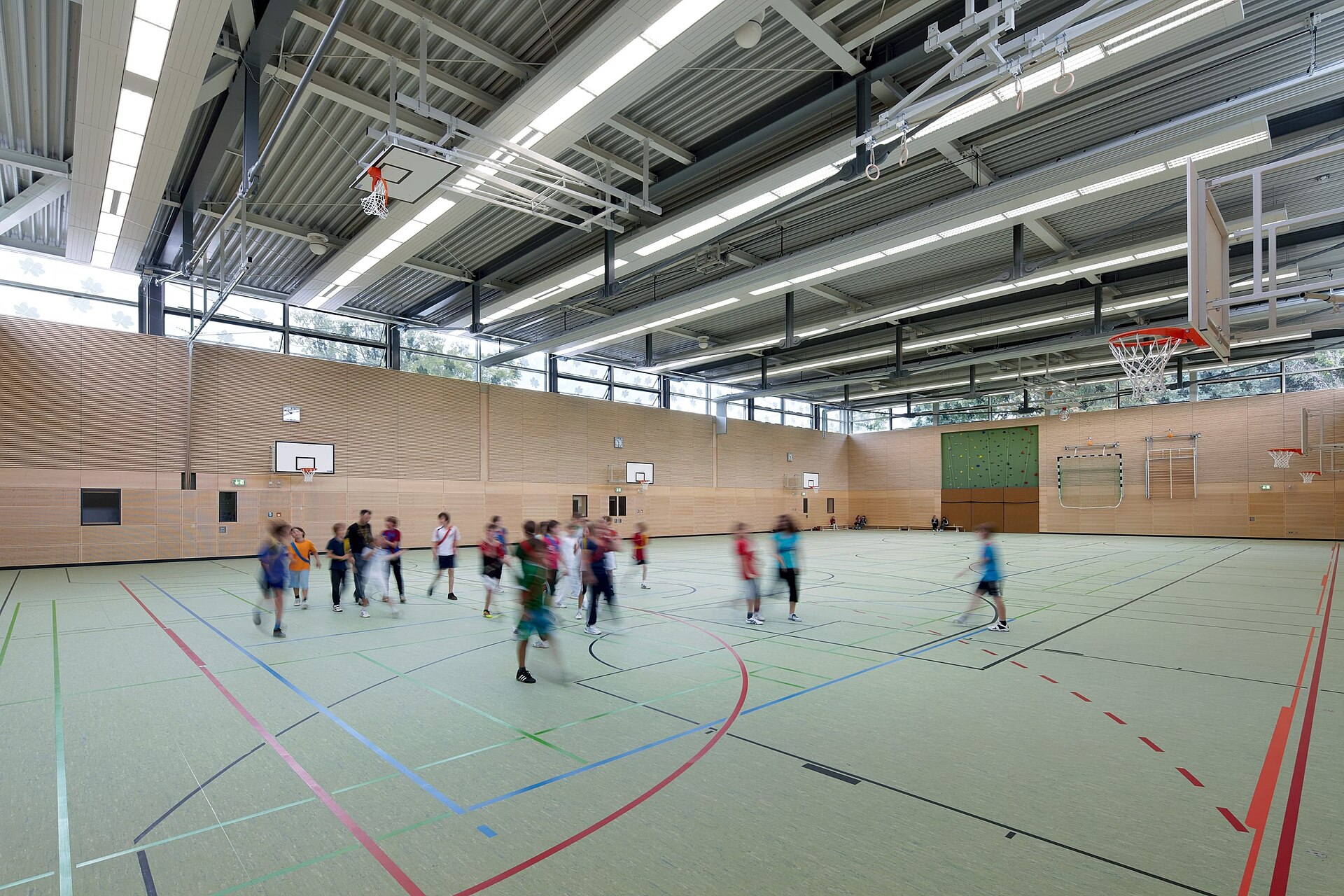
Ask where the boundary is in volleyball and the obvious answer is the net. The rules disagree, and the disagreement is written into a piece of equipment most spectators never notice.
Two rods
An antenna is a flexible rod, 1.80 m long and 10 mm in diameter, made of fibreglass or similar material. One is fastened at the outer edge of each side band, on opposite sides of the net. The top 80 cm of each extends above the net and is marked with 10 cm stripes of contrasting colour, preferably red and white.
Reference The antenna’s dimensions, material, placement at the outer edge of each side band, and the 80 cm marked section extending above the net, from Rule 2.4.
Then the sentence that changes what a volleyball court is:
The antennae are considered as part of the net and laterally delimit the crossing space.
Reference That the antennae are considered part of the net and laterally delimit the crossing space, from Rule 2.4.
Two things follow. First, a rod standing mostly in the air above the net is legally the net, so touching it carries the consequences of touching the net. Second — and this is the structural point — the thing a ball must cross is not a plane. It is a crossing space: a defined volume, bounded on each side by an antenna and below by the net.
A ball travelling over the net but outside an antenna has not crossed. It has gone past the doorway rather than through it.
Why the doorway is narrower than the court
The court is 9 m wide. The net is 9.50 to 10 m long, with 25 to 50 cm of it hanging past the side bands at each end.
Reference The net’s structure — 1 m wide with a ±3 cm tolerance, 9.50 to 10 m long, with 25 to 50 cm on each side of the side bands — from Rule 2.2.
The antennae are at the side bands, which sit at the court’s sidelines. So the crossing space is exactly as wide as the court, while the net itself is up to a metre wider — and that overhang is not a target. It is there to be tensioned and to stop the ball squeezing between the net and the post.
The posts are further out still: placed 0.50 to 1.00 m outside the sidelines, 2.55 m high, and for FIVB and official competitions exactly 1 m outside and padded.
Reference The posts’ placement 0.50–1.00 m outside the side lines, their 2.55 m height, and the requirement in FIVB and official competitions that they be 1 m outside and padded, from Rule 2.5.
Three concentric widths, then: the crossing space at 9 m, the net at 9.50–10 m, the posts at 10–11 m. Only the innermost one is a boundary of play. The other two exist to hold it up and to keep people from running into it.
The height that is measured in the middle
The net’s height is where volleyball diverges most sharply from the other net sports.
The net’s top sits at 2.43 m for men and 2.24 m for women, and — this is the part that matters — its height is taken at the centre of the playing court, with the ends required to match it and permitted to sit at most 2 cm high.
Reference The net heights of 2.43 m and 2.24 m, the measurement point at the centre of the playing court, and the requirement that the height over both side lines be the same and no more than 2 cm above the official height, from Rules 2.1.1 and 2.1.2.
Read that as an engineering instruction. The measurement is taken at the centre — where a strung net sags most — and the rule then says the ends must match it, within 2 cm. In other words: tension the net until the middle is at the specified height, then check that you have not overtightened the ends by more than two centimetres.
Tennis does the opposite. Its net is specified at two different heights, 1.07 m at the posts and 0.914 m in the middle, with a strap that pulls the centre down. Volleyball asks for a level net and tolerates 2 cm of error. Tennis asks for a 15.6 cm drop and mandates the hardware to produce it.
Both are answers to the same physical fact — a cord strung between two posts sags — and they go in opposite directions because the sports want different things from the middle of the court.
The third dimension, twice
Volleyball is the only sport in this Journal’s corpus whose governing body specifies the space above the playing area as part of the venue.
The playing court is a rectangle measuring 18 by 9 m, surrounded by a free zone at least 3 m wide on all sides. The free playing space — the space above the playing area, free from any obstruction — must measure at least 7 m in height from the playing surface.
Reference The 18 by 9 m playing court, the free zone of at least 3 m on all sides, and the minimum 7 m of free playing space above the playing area, from Rule 1.1.
Seven metres of clear air, three metres of clear floor on every side, for a court that is itself only 162 m². The regulated volume is far larger than the regulated area, and it has to be: the decisive actions happen above the net, and a ball played high has to come down inside the lines without touching anything on the way.
Put the two together — 7 m of ceiling, and a crossing space bounded by two rods — and volleyball’s field of play resolves into something no plan view can show. It is a room with a doorway in the middle of it, and the rules specify the doorway more carefully than the room.
Read the evergreen pages
This piece is an argument. These are the reference pages on SocialSportHub that document the same subjects.
References
- [1]FIVBGoverning body. Official Volleyball Rules 2025–2028 — Rule 2, Net and posts, including height, structure, side bands, antennae and posts. Accessed 6 September 2026.
- [2]FIVBGoverning body. Official Volleyball Rules 2025–2028 — Rule 1, Playing area. Accessed 6 September 2026.
Continue reading
Editor’s pick
Volleyball's positions exist for one instant, and the sport is built in the gap
Rule 7.4 pins six players into a strict relative order — and only at the moment the server strikes the ball. Everything volleyball is known for happens in the fraction of a second after that constraint stops applying.
Editor’s pick
Three sports hang a cord between two posts, and all three answer the sag differently
A strung net always dips in the middle. Tennis decided to make the dip 156 millimetres and mandated a strap to produce it; badminton lets it be 26; volleyball forbids it and allows 20 millimetres of error. One physical fact, three regulatory answers.
More on volleyball
Five sports paint a line around the court. Only four of them agree it is part of it
A ball on the line is in, unless you are playing basketball, where the boundary line is not court at all. The disagreement is written into the rulebooks, and it decides which edge of the paint the tape measure is held against.